Hello Udo
Zitat:
..., but I have no idea where in the period it was last night.
Perhaps I can get this info at AAVSO?
Probably not at the AAVSO as they don't concentrate on EBs yet. The small euro-
pean VSOing orgs do much more work on EBs. So if you search for something on
EBs, its more likely to find it somewhere in Europe or Asia.
beta Lyr is a problematic case due to its brightness and long period. Therefore
most times of minimum (ToMs) are gained visually. And due to the relative slow
change in brightness, the light curves are usually sparse and the ToMs often not
very accurate. The visual ToMs usually show a scatter in the +/- 0.3 d range.
Therefore a single visual ToM is usually just accurate enough for determining a
phase value in the range +/- 0.02 [periods] in phase.
beta Lyr also shows minor cycle to cycle variations that even disturbe accurate
ToMs gained by PMT/PD/PC PEP and CCD measurements if they are reduced from
several periods. beta Lyr further shows an about constant increase in period which
makes the usage of linear elements useless over a longer time span.
The most complete set of ToMs is probably available via the BAV LkDB:
http://www.bav-astro.de/LkDB/index.php
(enter "bet Lyr" and press "Return")
The period change of beta Lyr is so fast that the O-C curves run away already
after a relative short time. A sign for this is the nearly vertical trails of observed
ToMs with the GCVS elements. Even with the usually yearly updated instant linear
elements of Kreiner one can see this effect already close in the past. When choos-
ing user elements and setting the period to 12.9345 d one gets a nice parabola
that shows the period increase clearly.
The Kreiner gives the parabolic elements for HJD:
http://www.as.up.krakow.pl/o-c/data/get ... BETA%20LYR
MinI = 2408247,9827 + 12,913817 * E + 3,859e-06 * E²
And the instant linear elements:
http://www.as.up.krakow.pl/ephem/LYR.HTM
http://www.as.up.krakow.pl/minicalc/LYRBETA.HTM
MinI = 2452510,25(+/-5) + 12,9421(+/-8)
But these instant linear elements of Kreiner give O-C values that are systematically
around -0.4 d when looking at the most recent visual ToMs that are already a few
years old (unfortunatly there are no recent PEP or CCD ToMs listed). This indicates
that they should be revised to reflect the actual current behaviour of beta Lyr.
When assuming that the parabolic elements are still about correct, one can calcu-
late the current linear period of beta Lyr that should be ~ 12,94176 d which is a
bit but not really significantly shorter than the one used for the instant linear ele-
ments of Kreiner. So judging from the recent visual ToMs (extrapolation assuming
parabolic behaviour in the recent 16 years) and using the above current linear pe-
riod, the preliminary instant linear elements for beta Lyr should be pretty close to:
MinI = 2455007,74 + 12,94176 * E
MinII = 2455014,21 + 12,94176 * E
These elements give practically identical HJDs as the above parabolic elements
(which can be taken as confirmation that both are probably OK).
Using these elements, the phase of beta Lyr was last night (2009-08-22 22:00 UT
= 24:00 CEST = JD 2455066.41667) close to 0,534. So it should have been close to
secondary minimum and therefore the line shifts due to the RV of the binary compo-
nents close to minimum, while line shifts due to mass transfer might have been close
to maximum. Does this fit you spectrum ?
Zitat:
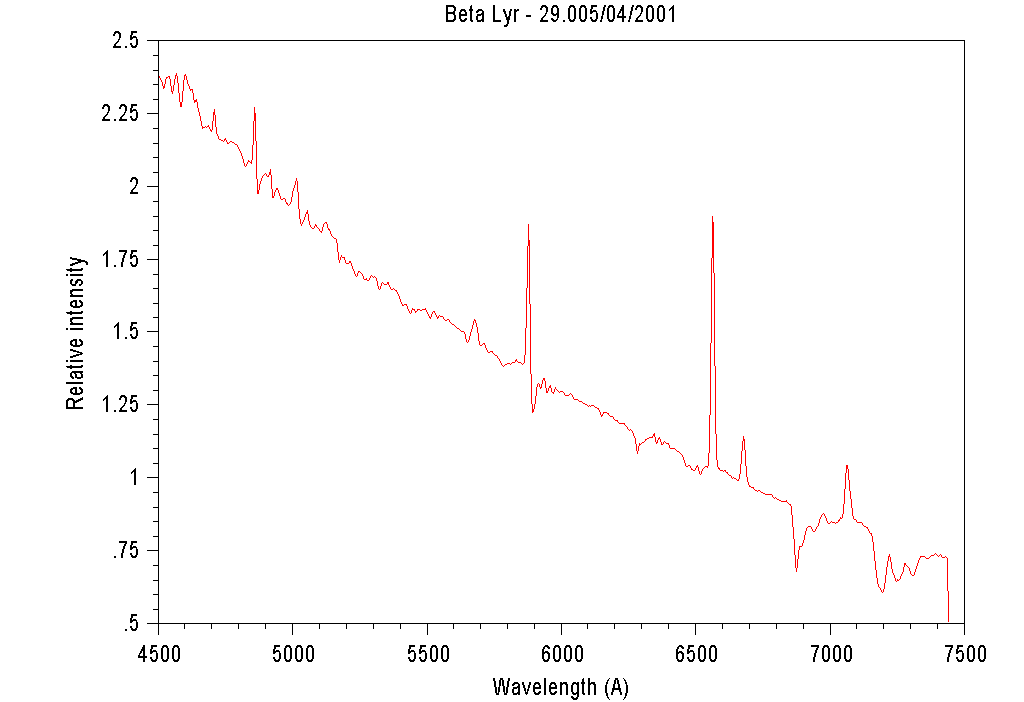
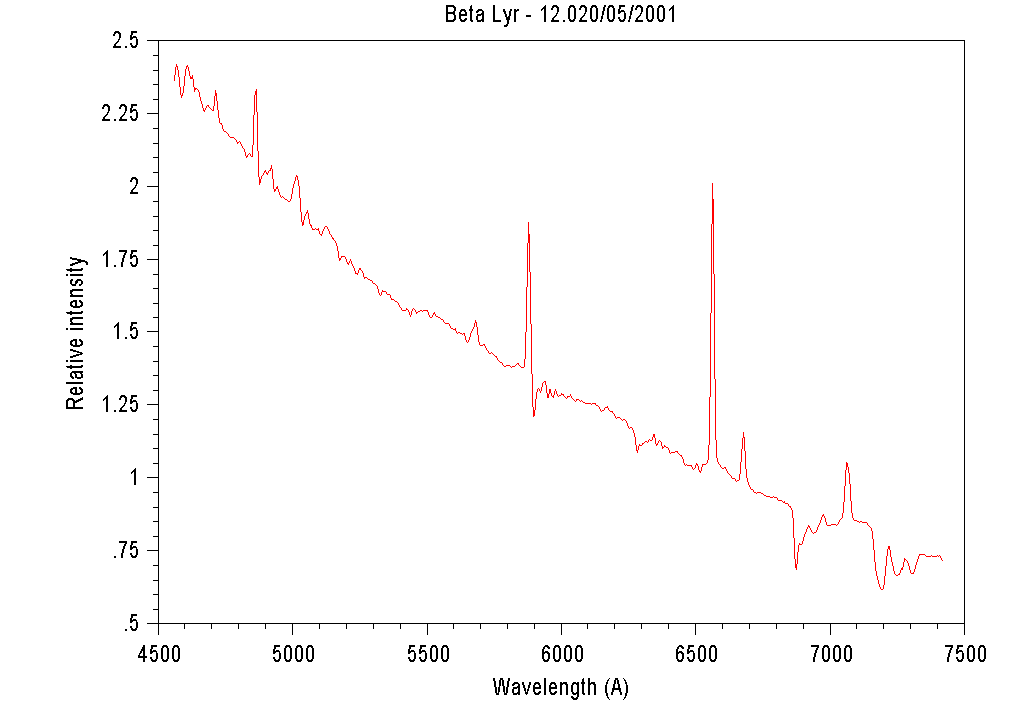
Again I have modified UFES and show you a first result, a spectrum of beta
lyrae (Shelyak). Extremly interesting, variable and multiple Star (Mag. 3.25-
4.36, period 12.91d), with many emission lines (partly P Cygni profiles).
Take a look at the beta Lyr pages of Christian Buil:
Peculiar stars corner:
http://www.astrosurf.com/buil/us/peculiar2/peculiar.htm
Beta Lyrae stars:
http://www.astrosurf.com/buil/us/peculiar2/betalyr.htm
http://www.astrosurf.com/buil/us/spectr ... 042001.gif
http://www.astrosurf.com/buil/us/spectr ... 042001.gif
http://www.astrosurf.com/buil/us/spectr ... 042001.gif
http://www.astrosurf.com/buil/us/spectr ... 052001.gif
At lower resolutions (~ 4 A/pixel) especially the line at ~ 589 nm (D line = Na
doublet?) shows a nice major change in the P Cyg profile that originates from
a "thick, opaque torus of matter orbiting and spiraling into it".
With a higher resolution one sees also RV variation changes/doubling in the single
lines like e.g. Halpha etc.:
Observing with the eShel spectrograph
http://www.astrosurf.com/buil/eshel3/review.htm
http://www.astrosurf.com/buil/eshel3/betalyr_1.jpg
http://www.astrosurf.com/buil/eshel3/ordre34_1.png
http://www.astrosurf.com/buil/eshel3/sp1.png
http://www.astrosurf.com/buil/eshel3/blyr1.png
http://www.astrosurf.com/buil/eshel3/blyr2.png
http://www.astrosurf.com/buil/eshel3/blyr3.png
Udo, if you spend some efford on the RV measurements of beta Lyr you might be
able to determine a more accurate E0 and phase from your high-res spectroscopic
RV measurements and some visual observers can do.
Clear skies
Wolfgang
--
Wolfgang Renz, Karlsruhe, Germany
 Registrieren
 Anmelden
 FAQ
FAQ Suche
Suche




 )
) .
. Da isses mit dem Erinnerungsvermögen nimmer so doll.