Forum der Vereinigung der Sternfreunde

Forum of the German Amateur Astronomy Association
Aktuelle Zeit: 07. Februar 2026, 17:51:05 PM

Alle Zeiten sind UTC+02:00


Ein neues Thema erstellen  Auf das Thema antworten  [ 56 Beiträge ]  Gehe zu Seite 1 2 Nächste
Autor Nachricht
 Betreff des Beitrags: New ProAm campaign in 2013
BeitragVerfasst: 08. Dezember 2011, 15:04:02 PM 
Offline
Meister

Registriert: 31. Juli 2006, 16:43:32 PM
Beiträge: 3468
Hi together!

In summer 2011 I have been on an international professional conference on massive stars to honour Tony Moffat for his four decades of research on these objects. After the successful Mons campaign on WR 140 in 2008/2009 together with Tony, a group of researchers decided to start a joint effort for a new professional-amateur (ProAm) campaign. During a late evening discussion including a lot of fun and good Canadian brew we decided to focus on two Wolf-Rayet stars (WR 134 and WR 135) for a very long time scale of four months. We decided to work on stochastic and periodic wind effects to get detailed information about the structure and conditions of the hidden stellar surfaces below the optically dense winds, and include spectroscopic AND photometric measurements.

The first choice WR stars are in the Cygnus constellation. They are relatively bright (about 8 mag), high in the sky during our campaign and data requirements can be matched with small size telescopes and standard equipment. The necessary preparation all over the world and the important definition and harmonization of different instrumental setup forced us to start with the campaign planning relatively early 1.5 years in advance. Especially amateurs can, hence, prepare themselves by doing (test) observations, perhaps even useful for the campaign, indeed.

During the last months Tony worked on the “science case” to define our goal and to have a basis for respective telescope proposals. To understand our goal and to understand the instrumental necessities I wrote a dedicated and permanently updated webpage, basically consisting on the science case (which perhaps needs some adjustments). This site can be found at www.stsci.de/wr134/index.htm. Our main exchange platform will be the VdS discussion forum (see link “Campaign forum” to the “ConVento” thread. All professionals are already registered.

Please check it out and think about your participation. Then use the link “How to join us”, download the Word file, fill it out and send it to me, as indicated. Then register in the forum (if not yet done) and enjoy the campaign progress.

A general remark: As soon as you announce your participation we strictly consider you as a team member and rely on your contribution. Please inform me (us) if this is not valid anymore so that we do not run into trouble. Information exchange is everything!

Cheers, Thomas


Nach oben
   
 Betreff des Beitrags: Choice of target(s)
BeitragVerfasst: 08. Dezember 2011, 16:56:47 PM 
Offline
Nutzer
Benutzeravatar

Registriert: 03. August 2011, 00:07:22 AM
Beiträge: 10
Wohnort: Vina del Mar, Chile
Dear all,

I am happy to see things moving on. I encourage everyone to share their ideas and to discuss the project here, on this Forum.

I would like to discuss the pertinence of the choice of the targets. I am myself very interested by the long term monitoring of WR 134, because I believe that this project can really benefit from a Pro-Am campaign. The following is a short paragraph that I would suggest to the webmaster to put in a new section of the web page entitled "Scientific Impact":
***

Morel et al. 1999, ApJ, 518, 428 ("A 2.3 Day Periodic Variability in the Apparently Single Wolf-Rayet Star WR 134: Collapsed Companion or Rotational Modulation?") have found a coherent 2.25+/-0.05 day periodicity in the line-profile changes of He II 4686, although the global pattern of variability is different from one epoch to another. The same period has been (marginally) found in UBV photometry. This makes it one of the three WR stars (with WR1 (Chené & St-Louis 2010, ApJ, 716, 929) and WR6 (Morel et al. 1997, ApJ, 482, 470)) for which large scale spectral variations, likely to be caused by the presence of CIRs in the wind, have been observed. However, since then, WR 134 has never been monitored a second time. Hence, it would be valuable to confirm the currently known period and variability pattern. Moreover, none of these three WR star showing CIR has been monitored on a very long time interval in spectroscopy. Such a monitoring would give us information on the epoch dependency, the long term variability pattern and the evolution of the period, if there is any. Also, it would be very interesting to look for a periodicity in the epoch dependency; it would give us invaluable information on the origin of CIRs (would it by magnetic field activity at the surface, stellar pulsations or something else)! Such study has never been done yet, since none of the previous spectroscopic campaign has been covering more than a month (contiguously).
***

On the other hand, I don't see yet how monitoring clumps in WR 135 could have an equivalent impact. Moreover, WR 134 would benefit from the best time sampling possible, since the period is "only" 2.3 days, and the complexity of the variations combined with the epoch dependency renders difficult the analysis of datasets that are not sufficiently intensives. Can someone tell me why we should "split" our efforts on two stars and what would be the benefit of monitoring WR 135, considering that this star has been already extensively studied by Robert 1992 (her PhD thesis) and Lépine & Moffat 1999 ApJ., 514, 909?

Long live the Pro-Am campaign 2013!

André-Nicolas Chené

_________________
André-Nicolas Chené
Postdoctorado
Universidad de Concepcion
Universidad de Valparaiso


Zuletzt geändert von Andrenicolas Chene am 13. Dezember 2011, 21:47:35 PM, insgesamt 1-mal geändert.

Nach oben
   
 Betreff des Beitrags: Choice of line(s)
BeitragVerfasst: 08. Dezember 2011, 17:07:50 PM 
Offline
Nutzer
Benutzeravatar

Registriert: 03. August 2011, 00:07:22 AM
Beiträge: 10
Wohnort: Vina del Mar, Chile
Dear all,

Now, I would like to address the question of the spectral line(s) we want to monitor. In the project description, it is mentioned that HeII5411 is the ideal line for WR134. I agree that this line is nice, but I believe that HeII4686 is much better. It is bigger, hence easier to observe with the required S/N, and it is more variable, since its intensity depends of the density to the square. Therefore, I would put HeII4686 as the prime "target", and HeII5411 and HeI5876 as interesting lines to monitor, if available.

Cheer,

André-Nicolas Chené

_________________
André-Nicolas Chené
Postdoctorado
Universidad de Concepcion
Universidad de Valparaiso


Nach oben
   
 Betreff des Beitrags: New ProAm campaign in 2013
BeitragVerfasst: 08. Dezember 2011, 17:22:54 PM 
Offline
Meister

Registriert: 31. Juli 2006, 16:43:32 PM
Beiträge: 3468
Hi André-Nicolas, I added a link „The impact“.

Cheers, Thomas


Nach oben
   
 Betreff des Beitrags: New ProAm campaign in 2013
BeitragVerfasst: 08. Dezember 2011, 18:01:30 PM 
Offline
Neueinsteiger

Registriert: 20. Februar 2008, 15:33:12 PM
Beiträge: 2
Dear all,

Just a precision about WR 134. Actually, the period has also been found
completely independently back in 1994 by McCandliss et al.
(http://adsabs.harvard.edu/abs/1994Ap%26SS.221..155M). So there is
strong evidence that this period is real (by the way, they were the
first to report this periodicity and so they deserve some credit, I
think; I only confirmed it). As pointed out by André-Nicolas, the period
is always present in the line-profile variations but the pattern of
variability is epoch dependent. Following the variations over a long
time span would allow us to study this long-term behaviour (is it
smoothly or abruptly changing?, etc.), and so this is clearly of interest.

Cheers,
Thierry

Andrenicolas Chene wrote:
Zitat:
Dear all,

I am happy to see things moving on. I encourage everyone to share
their ideas and to discuss the project here, on this Forum.

I would like to discuss the pertinence of the choice of the targets. I
am myself very interested by the long term monitoring of WR 134,
because I believe that this project can really benefit from a Pro-Am
campaign. The following is a short paragraph that I would suggest to
the webmaster to put in a new section of the web page entitled
"Scientific Impact":
***

Morel et al. 1999, ApJ, 518, 428 ("A 2.3 Day Periodic Variability in
the Apparently Single Wolf-Rayet Star WR 134: Collapsed Companion or
Rotational Modulation?") have found a coherent 2.25+/-0.05 day
periodicity in the line-profile changes of He II 4686, although the
global pattern of variability is different from one epoch to another.
The same period has been (marginally) found in UBV photometry. This
makes it one of the three WR stars (with WR1 (Chené & St-Louis 2010,
ApJ, 716, 929) and WR6 (Morel et al. 1997, ApJ, 482, 470)) for which
large scale spectral variations, likely to be caused by the presence
of CIRs in the wind, have been observed. However, since then, WR 134
has never been monitored a second time. Hence, it would be valuable to
confirm the currently known period and variability pattern. Moreover,
none of these three WR star showing CIR has been monitored on a very
long time interval in spectroscopy. Such a monitoring would give us
information on the epoch dependency, the long term variability pattern
and the evolution of the period, if there is any. Also, it would be
very interesting to look for a periodicity in the epoch dependency; it
would give us invaluable information on the origin of CIRs (would it
by magnetic field activity at the surface, stellar pulsations or
something else)! Such study has never been done yet, since none of the
previous spectroscopic campaign has been covering more than a month
(contiguously).
***

On the other hand, I don't see yet how monitoring clumps in WR 135
could have an equivalent impact. Moreover, WR 134 would benefit from
the best time sampling possible, since the period is "only" 2.3 days,
and the complexity of the variations combined with the epoch
dependency renders difficult the analysis of datasets that are not
sufficiently intensives. Can someone tell me why we should "split" our
efforts on two stars and what would be the benefit of monitoring WR
135, considering that this star has been already extensively studied
by Robert 1992 (her PhD thesis) and Lépine & Moffat 1999 ApJ., 514, 909?

Long live the Pro-Am campaign 2013!

André-Nicolas Chené


------------------------------------------------------------------------

--------------------------
André-Nicolas Chené
Postdoctorado
Universidad de Concepcion
Universidad de Valparaiso


-------------------- m2f --------------------

FG Spektroskopie Mailingliste

Sie finden dieses Thema im Forum unter:
http://spektroskopieforum.vdsastro.de/v ... 0430#20430

-------------------- m2f --------------------


Nach oben
   
 Betreff des Beitrags:
BeitragVerfasst: 08. Dezember 2011, 20:39:16 PM 
Offline
Meister
Benutzeravatar

Registriert: 01. August 2006, 16:08:56 PM
Beiträge: 3866
Wohnort: 68163 Mannheim
Hello Thomas and all other friends,

this campaign seems to me very interesting. So I would like to join it....and thanks for your efforts to create a new ProAm campaign !

But the measurements on such faint stars ( 8.3 mag) are a big challenge for me and my optical set (C14, Lhires III slit littrow).

But there is a chance (and Robert Trambley realized it). Taking the 1200 or the 1800 g/mm grating and a slit with of 35 to 50 micrometers there should be possible S/N > 100 in 1 h observation time (R ~ 4,000 to 5,000 ~ 1.2 A resolution, dispersion 0.2 A/Pix, see annexe).

Because my ThAr-calibration unit (light injected over a fiber) I can deliver also calibration spectra in the spectral region < 550 nm.

I'll take first exposures in the next time to test my set. Then we can decide if my contribution is of interest.


Dateianhänge:
simspec_slit_schanne.xls [95.5 KiB]
343-mal heruntergeladen

_________________
Herzliche Grüße / best regards

Lothar

https://lotharschanne.wordpress.com/
Nach oben
   
 Betreff des Beitrags: New ProAm campaign in 2013
BeitragVerfasst: 08. Dezember 2011, 23:02:25 PM 
Offline
Dauernutzer

Registriert: 06. Februar 2008, 22:45:45 PM
Beiträge: 101
Wohnort: Montreal
Hi hANCk:

Yes, but if one is restricted in wavelength coverage )non-echelle), then CIII 5696 is best for clumps in WR135.
Then HeII 5411 in WR134 is fairly close to that and better than HeII 4686. That's the main reason for choosing 5411 instead of 4686. But I agree that 4686 is to be preferred, if one has the choice (which one
may not with restricted coverage).

Cheers, Tony
Zitat:
----- Original Message -----
From: Andrenicolas Chene (fg-spek-convento@vds-astro.de)
To: fg-spek-convento@vds-astro.de (fg-spek-convento@vds-astro.de)
Sent: Thursday, December 08, 2011 10:07 AM
Subject: [fg-spek] Re: New ProAm campaign in 2013


Dear all,

Now, I would like to address the question of the spectral line(s) we want to monitor. In the project description, it is mentioned that HeII5411 is the ideal line for WR134. I agree that this line is nice, but I believe that HeII4686 is much better. It is bigger, hence easier to observe with the required S/N, and it is more variable, since its intensity depends of the density to the square. Therefore, I would put HeII4686 as the prime "target", and HeII5411 and HeI5876 as interesting lines to monitor, if available.

Cheer,

André-Nicolas Chené


--------------------------
André-Nicolas Chené
Postdoctorado
Universidad de Concepcion
Universidad de Valparaiso


_________________
Tony Moffat


Nach oben
   
 Betreff des Beitrags:
BeitragVerfasst: 09. Dezember 2011, 09:42:54 AM 
Offline
Meister

Registriert: 31. Juli 2006, 16:43:32 PM
Beiträge: 3468
Hi Tony!
Zitat:
Yes, but if one is restricted in wavelength coverage )non-echelle), then CIII 5696 is best for clumps in WR135.
Then HeII 5411 in WR134 is fairly close to that and better than HeII 4686. That's the main reason for choosing 5411 instead of 4686. But I agree that 4686 is to be preferred, if one has the choice (which one
may not with restricted coverage).
Here I disagree! We are early with our planning and I would prefer to keep our options open and focusing on the science goals. If we have a lot of observers and we can allocate certain wavelength regions (not moving grating) then we do not need to take the individual wavelength intervals into account. If one does not cover a line than maybe the other with a different setup. So, we definitely should focus on HeII 4686, as well.

In addition, there are some, although not many, Echelle spectrographs in the amateur community.

So, as soon as we know how big our group will be then, and only thenm we should choose (and reject) certain lines.

Cheers, Thomas


Nach oben
   
 Betreff des Beitrags:
BeitragVerfasst: 10. Dezember 2011, 17:02:42 PM 
Offline
Meister
Benutzeravatar

Registriert: 25. Oktober 2006, 23:43:13 PM
Beiträge: 741
Wohnort: Cumbria England
Zitat:
Hello Thomas and all other friends,

But the measurements on such faint stars ( 8.3 mag) are a big challenge for me and my optical set (C14, Lhires III slit littrow).

.

A big challenge for me also. I could perhaps get SNR >100 at 2.5A resolution with my 280mm aperture C11 and LHIRES with a 600l/mm grating.

I think there are not many amateur spectroscopists who have enough aperture (>=0.5m?) to meet the target of 1A resolution at 200 SNR in 1 hour on these targets.

Cheers
Robin


Nach oben
   
 Betreff des Beitrags: New ProAm campaign in 2013
BeitragVerfasst: 10. Dezember 2011, 23:57:35 PM 
Offline
Dauernutzer

Registriert: 25. August 2010, 15:29:29 PM
Beiträge: 63
Wohnort: Montpellier
Hello,nice targets and noble proposal, but i do agree with Robin that it is very challenging, if not impossible at the aim resolution with an amateur telescope. The SNR required is high
Secondly, what is the problem about continuum of WR star with eshell spectra ? Could you explain ?
Cheers 
Thierry Garrel 

2011/12/10 Robin Leadbeater <fg-spek-convento@vds-astro.de (fg-spek-convento@vds-astro.de)>
Zitat:
Lothar Schanne wrote: Hello Thomas and all other friends,


But the measurements on such faint stars ( 8.3 mag) are a big challenge for me and my optical set (C14, Lhires III slit littrow).


.


A big challenge for me also. I could perhaps get SNR >100 at 2.5A resolution with my 280mm aperture C11 and LHIRES with a 600l/mm grating.

I think there are not many amateur spectroscopists who have enough aperture (>=0.5m?) to meet the target of 1A resolution at 200 SNR in 1 hour on these targets.

Cheers
Robin


_________________
Thierry Garrel
Observatoire de Fontcaude, Montpellier, France
SpectroBlog http://gabalou.canalblog.com/


Nach oben
   
 Betreff des Beitrags:
BeitragVerfasst: 11. Dezember 2011, 12:12:03 PM 
Offline
Meister

Registriert: 31. Juli 2006, 16:43:32 PM
Beiträge: 3468
Hi Thierry!
Zitat:
Secondly, what is the problem about continuum of WR star with eshell spectra ? Could you explain ?
An Echelle spectrograph delivers a sensitivity function for each order, like a single Blaze grating. This function needs to be connected from order to order. For WR stars without continuum this introduces a lot of work and difficulties. But it can be solved, of course. So Echelle spectra are important due to their unbeatable capabilities for RV measurements and simultaneous investigation of different line species. But keep in mind: A fiber-fed spectrograph looses efficience.

With respect to the S/N challange we should continue this discussion. I believe, a campaign without challanges would not deliver state-of-the-art results. But need some input from the pro's.

Cheers, Thomas


Nach oben
   
 Betreff des Beitrags: New ProAm campaign in 2013
BeitragVerfasst: 11. Dezember 2011, 15:31:20 PM 
Offline
Meister
Benutzeravatar

Registriert: 19. August 2006, 11:45:20 AM
Beiträge: 2740
Wohnort: 66907 Glan-Münchweiler
Hallo,
Robin is right ..... the discussed stars are very weak .... at least fiber coupled echellespektrographs can not be used here from amateurs..... Usual slitspectrograh in the configuration as described by Lothar and Robin
seems possible for amateurs , especially if it can be tracked with high precision even in the hour axis, so that the slit is illuminated without interruption!!!

Where are the coordinates of the objects?

cheers berthold


Nach oben
   
 Betreff des Beitrags: New ProAm campaign in 2013
BeitragVerfasst: 11. Dezember 2011, 16:48:05 PM 
Offline
Dauernutzer

Registriert: 23. Februar 2008, 19:33:52 PM
Beiträge: 100
Hi Berthold, I believe these are the details:

WR 134 / V1769 Cyg / HD 191765 / HIP 99377
RA: 20 10 14.20
Dec: +36 10 35.1
vmag: 8.23
type: WN6

WR 135 / V1042 Cyg / HD 192103 / HIP 99525
RA: 20 11 53.53
Dec: +36 11 50.6
vmag: 8.36
type: WC8

Cheers,

Fil.

On Sun, Dec 11, 2011 at 2:12 PM, Berthold Stober
<fg-spek-convento@vds-astro.de> wrote:
Zitat:
Hallo,
Robin is right ..... the discussed stars are very weak .... at least fiber
coupled echellespektrographs can not be used here from amateurs..... Usual
slitspectrograh in the configuration as described by Lothar and Robin
seems possible for amateurs , especially if it can be tracked with high
precision even in the hour axis, so that the slit is illuminated without
interruption!!!

Where are the coordinates of the objects?

cheers berthold


-------------------- m2f --------------------

FG Spektroskopie Mailingliste

Sie finden dieses Thema im Forum unter:
http://spektroskopieforum.vdsastro.de/v ... 0441#20441

-------------------- m2f --------------------

_________________
Fil.


Nach oben
   
 Betreff des Beitrags: New ProAm campaign in 2013
BeitragVerfasst: 11. Dezember 2011, 17:09:57 PM 
Offline
Meister
Benutzeravatar

Registriert: 25. Oktober 2006, 23:43:13 PM
Beiträge: 741
Wohnort: Cumbria England
Hi all,

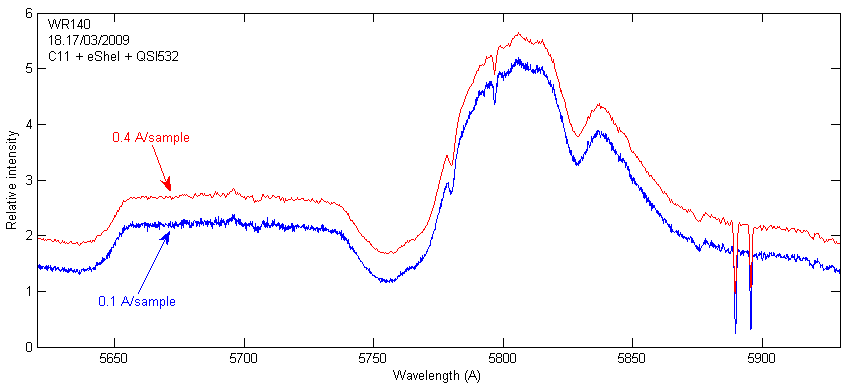
Here is an example of WR140 taken by Christian Buil using an eShel echelle spectrograph (native resolution ~0.6A) filtered to ~0.8A resolution (red line)
http://astrosurf.com/buil/eshel3/wr140_2.png
from this page
http://astrosurf.com/buil/eshel3/review.htm

This was a 35 min exposure using 280mm aperture

Vmag are: WR140 6.9 WR134 8.0 WR135 8.1


Cheers
Robin


----- Original Message ----- From: Thomas Eversberg (fg-spek-convento@vds-astro.de)
To: fg-spek-convento@vds-astro.de (fg-spek-convento@vds-astro.de)
Sent: Sunday, December 11, 2011 10:12 AM
Subject: [fg-spek] Re: New ProAm campaign in 2013


Hi Thierry!
Zitat: Secondly, what is the problem about continuum of WR star with eshell spectra ? Could you explain ?
An Echelle spectrograph delivers a sensitivity function for each order, like a single Blaze grating. This function needs to be connected from order to order. For WR stars without continuum this introduces a lot of work and difficulties. But it can be solved, of course. So Echelle spectra are important due to their unbeatable capabilities for RV measurements and simultaneous investigation of different line species. But keep in mind: A fiber-fed spectrograph looses efficience.

With respect to the S/N challange we should continue this discussion. I believe, a campaign without challanges would not deliver state-of-the-art results. But need some input from the pro's.

Cheers, Thomas


Nach oben
   
 Betreff des Beitrags: New ProAm campaign in 2013
BeitragVerfasst: 11. Dezember 2011, 17:19:32 PM 
Offline
Meister
Benutzeravatar

Registriert: 25. Oktober 2006, 23:43:13 PM
Beiträge: 741
Wohnort: Cumbria England
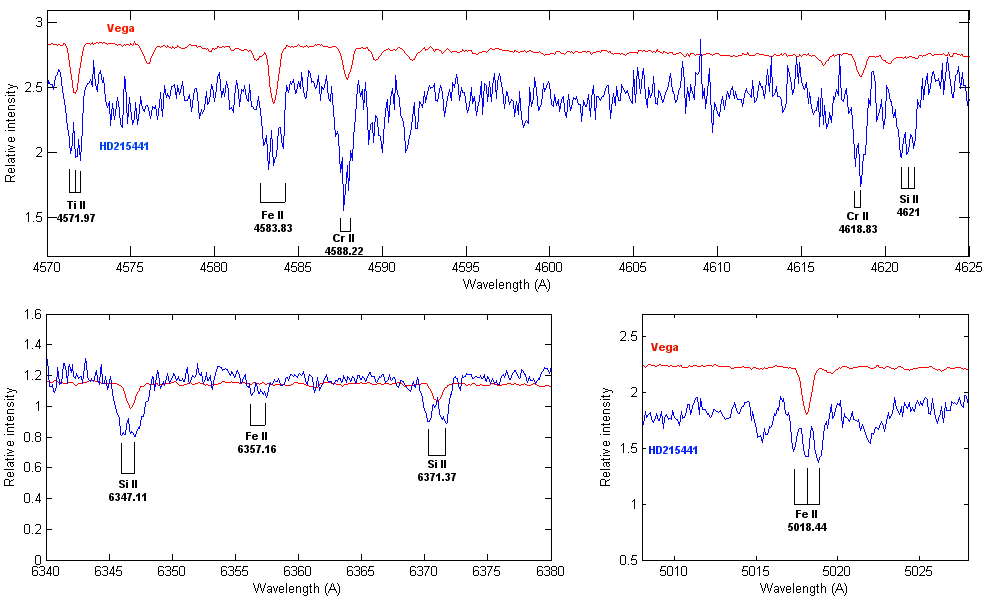
Also on the same page A0p star HD215441 at Vmag 8.6 using 90min exposure uisng the same equipment
http://astrosurf.com/buil/eshel3/hd215441.png

The SNR at this magnitude is clearly < 100 though

Robin

----- Original Message ----- From: Robin Leadbeater (robin@threehillsobservatory.co.uk)
To: fg-spek-convento@vds-astro.de (fg-spek-convento@vds-astro.de)
Sent: Sunday, December 11, 2011 3:09 PM
Subject: Re: [fg-spek] Re: New ProAm campaign in 2013


Hi all,

Here is an example of WR140 taken by Christian Buil using an eShel echelle spectrograph (native resolution ~0.6A) filtered to ~0.8A resolution (red line)
http://astrosurf.com/buil/eshel3/wr140_2.png
from this page
http://astrosurf.com/buil/eshel3/review.htm

This was a 35 min exposure using 280mm aperture

Vmag are: WR140 6.9 WR134 8.0 WR135 8.1


Cheers
Robin


----- Original Message ----- From: Thomas Eversberg (fg-spek-convento@vds-astro.de)
To: fg-spek-convento@vds-astro.de (fg-spek-convento@vds-astro.de)
Sent: Sunday, December 11, 2011 10:12 AM
Subject: [fg-spek] Re: New ProAm campaign in 2013


Hi Thierry!
Zitat: Secondly, what is the problem about continuum of WR star with eshell spectra ? Could you explain ?
An Echelle spectrograph delivers a sensitivity function for each order, like a single Blaze grating. This function needs to be connected from order to order. For WR stars without continuum this introduces a lot of work and difficulties. But it can be solved, of course. So Echelle spectra are important due to their unbeatable capabilities for RV measurements and simultaneous investigation of different line species. But keep in mind: A fiber-fed spectrograph looses efficience.

With respect to the S/N challange we should continue this discussion. I believe, a campaign without challanges would not deliver state-of-the-art results. But need some input from the pro's.

Cheers, Thomas


Nach oben
   
 Betreff des Beitrags: New ProAm campaign in 2013
BeitragVerfasst: 11. Dezember 2011, 18:21:03 PM 
Offline
Meister
Benutzeravatar

Registriert: 19. August 2006, 11:45:20 AM
Beiträge: 2740
Wohnort: 66907 Glan-Münchweiler
Yes, ok Robin, but you must see, that shelyak' s echelle cannot be considered as an echellespek made by amateurs.....

cheers berthold


Nach oben
   
 Betreff des Beitrags: New ProAm campaign in 2013
BeitragVerfasst: 11. Dezember 2011, 18:23:16 PM 
Offline
Meister
Benutzeravatar

Registriert: 19. August 2006, 11:45:20 AM
Beiträge: 2740
Wohnort: 66907 Glan-Münchweiler
Thank you Fil.....

berthold
Zitat:
----- Original Message -----
From: Filipe Dias (fg-spek-convento@vds-astro.de)
To: fg-spek-convento@vds-astro.de (fg-spek-convento@vds-astro.de)
Sent: Sunday, December 11, 2011 4:05 PM
Subject: [fg-spek] Re: New ProAm campaign in 2013


Hi Berthold, I believe these are the details:

WR 134 / V1769 Cyg / HD 191765 / HIP 99377
RA: 20 10 14.20
Dec: +36 10 35.1
vmag: 8.23
type: WN6

WR 135 / V1042 Cyg / HD 192103 / HIP 99525
RA: 20 11 53.53
Dec: +36 11 50.6
vmag: 8.36
type: WC8

Cheers,

Fil.

On Sun, Dec 11, 2011 at 2:12 PM, Berthold Stober
)vds-astro.de> wrote:
: Hallo,
Robin is right ..... the discussed stars are very weak .... at least fiber
coupled echellespektrographs can not be used here from amateurs..... Usual
slitspectrograh in the configuration as described by Lothar and Robin
seems possible for amateurs , especially if it can be tracked with high
precision even in the hour axis, so that the slit is illuminated without
interruption!!!

Where are the coordinates of the objects?

cheers berthold


Fil.


Nach oben
   
 Betreff des Beitrags: Beginner
BeitragVerfasst: 12. Dezember 2011, 00:08:05 AM 
Offline
Dauernutzer
Benutzeravatar

Registriert: 08. März 2011, 03:51:19 AM
Beiträge: 124
Wohnort: San Luis Potosi, Mexico
Hi,

I have been reading this and I would like to ask.

I have a Mewlon 250mm which I can reduce to f/9.6 as well as an 8" RC at f/8.0.

¿ What Lhires III configuration (grating ¿? lines per mm) would I need in order to get the proposed data ?
Zitat:
Resolution should be no worse than 1 Å, i.e. normally 0.3-0.5 Å/pixel.

Signal-to-noise S/N should be no worse than 200.
Maybe I will get a LhiresIII if it does make sense.

I imaged WR 134 this year on August 17th with an 8" RC and a LISA spectrograph at 2.949 Angström per pixel. Exposure time 6x 300s using a QSI520i cooled down to -15°C. Applied Dark and Bias and then median stacked in MaxImDL.

Look below my result

Bild

Bild

I could image in August 2013 for about 2-3 weeks if it makes sense

Thanks for your comments in advance.

_________________
Grüsse Rainer www.rsfotografia.com
Bild


Zuletzt geändert von Rainer Ehlert am 13. Dezember 2011, 23:51:50 PM, insgesamt 1-mal geändert.

Nach oben
   
 Betreff des Beitrags: New ProAm campaign in 2013
BeitragVerfasst: 12. Dezember 2011, 01:39:33 AM 
Offline
Meister
Benutzeravatar

Registriert: 25. Oktober 2006, 23:43:13 PM
Beiträge: 741
Wohnort: Cumbria England
Hi Rainer,

A 1200 l/mm grating would be the best match to the required ~1A resolution but as far as I can tell, it is unlikely to be possible to reach the required SNR with this sort of aperture. I am waiting to see what Lothar with a LHIRES and Thierry with an eShel can achieve on these targets with their 350mm aperture C14s This should give us a good idea of what aperture will be needed.

Robin

----- Original Message ----- From: Rainer Ehlert (fg-spek-convento@vds-astro.de)
To: fg-spek-convento@vds-astro.de (fg-spek-convento@vds-astro.de)
Sent: Sunday, December 11, 2011 10:08 PM
Subject: [fg-spek] Re: New ProAm campaign in 2013


Hi,

I have been reading this and I would like to ask.

I have a Mewlon 250mm which I can reduce to f/9.6 as well as an 8" RC at f/8.0.

¿ What Lhires III configuration (grating ¿? lines per mm) would I need in order to get the proposed data ?

Quote: Resolution should be no worse than 1 Å, i.e. normally 0.3-0.5 Å/pixel.

Signal-to-noise S/N should be no worse than 200.

Maybe I will get a LhiresIII if it does make sense.

I imaged WR 134 this year on August 17th with an 8" RC and a LISA spectrograph at 2.949 Ängström per pixel. Exposure time 6x 300s using a QSI520i cooled down to -15°C. Applied Dark and Bias and then median stacked in MaxImDL.

Look below my result

Bild 800)this.width = (800)">

Bild 800)this.width = (800)">

I could image in August 2013 for about 2-3 weeks if it makes sense

Thanks for your comments in advance.


Grüsse Rainer

" Wenn es funktionert, sollte man es nicht reparieren "

www.rsfotografia.com


Nach oben
   
 Betreff des Beitrags: New ProAm campaign in 2013
BeitragVerfasst: 12. Dezember 2011, 01:57:58 AM 
Offline
Dauernutzer

Registriert: 23. Februar 2008, 19:33:52 PM
Beiträge: 100
Hi Rainer,

The dispersion of 0.5 A/pixel comes out of the Lhires only from the combination of pixel size and grating.
At 6000A, the gratings should give a dispersion in Angs/micron (so you can multiply by pixel size in microns ;-):
2400 l/mm - 0.014 A/um
1200 l/mm - 0.039 A/um
600 l/mm - 0.082 A/um

Or we can divide 0.5 A/pix by these values, and get the size of the pixels that should be used to reach that dispersion:

2400 l/mm - 35 um
1200 l/mm -  12.8 um
600 l/mm - 6 um

If we think that ruled 600 l/mm gratings are more efficient than holographic 1200 and 2400 l/mm gratings, we get a suggestive hint for what to use if sensor's sensitivity is equivalent.. :)

_________________
Fil.


Nach oben
   
 Betreff des Beitrags: New ProAm campaign in 2013
BeitragVerfasst: 12. Dezember 2011, 02:22:40 AM 
Offline
Meister
Benutzeravatar

Registriert: 25. Oktober 2006, 23:43:13 PM
Beiträge: 741
Wohnort: Cumbria England
Hi Fil,

This is only part of the calculation. Matching the slit width which is needed to give the required resolution to the size of the star image is generally the more critical area. If this is significantly narrower than your star image size, you will lose light. Here, this would be the case with a 600 l/mm grating. The spreadsheet that Lothar posted shows the full calculation for a LHIRES and 1200 l/mm grating.

Cheers
Robin


----- Original Message -----
From: Filipe Dias (fg-spek-convento@vds-astro.de)
To: fg-spek-convento@vds-astro.de (fg-spek-convento@vds-astro.de)
Sent: Sunday, December 11, 2011 11:58 PM
Subject: [fg-spek] Re: New ProAm campaign in 2013


Hi Rainer,

The dispersion of 0.5 A/pixel comes out of the Lhires only from the combination of pixel size and grating.
At 6000A, the gratings should give a dispersion in Angs/micron (so you can multiply by pixel size in microns ;-):
2400 l/mm - 0.014 A/um
1200 l/mm - 0.039 A/um
600 l/mm - 0.082 A/um

Or we can divide 0.5 A/pix by these values, and get the size of the pixels that should be used to reach that dispersion:

2400 l/mm - 35 um
1200 l/mm - 12.8 um
600 l/mm - 6 um

If we think that ruled 600 l/mm gratings are more efficient than holographic 1200 and 2400 l/mm gratings, we get a suggestive hint for what to use if sensor's sensitivity is equivalent.. :)

Best regards,

Fil.

On Sun, Dec 11, 2011 at 10:08 PM, Rainer Ehlert )vds-astro.de (fg-spek-convento(==>)vds-astro.de ([email]fg-spek-convento(==>)vds-astro.de[/email]))> wrote:
: Hi,

I have been reading this and I would like to ask.

I have a Mewlon 250mm which I can reduce to f/9.6 as well as an 8" RC at f/8.0.

¿ What Lhires III configuration (grating ¿? lines per mm) would I need in order to get the proposed data ?

Quote: Resolution should be no worse than 1 Å, i.e. normally 0.3-0.5 Å/pixel.

Signal-to-noise S/N should be no worse than 200.

Maybe I will get a LhiresIII if it does make sense.

I imaged WR 134 this year on August 17th with an 8" RC and a LISA spectrograph at 2.949 Ängström per pixel. Exposure time 6x 300s using a QSI520i cooled down to -15°C. Applied Dark and Bias and then median stacked in MaxImDL.

Look below my result


I could image in August 2013 for about 2-3 weeks if it makes sense

Thanks for your comments in advance.


Grüsse Rainer

" Wenn es funktionert, sollte man es nicht reparieren "

www.rsfotografia.com


.


Fil.


Nach oben
   
 Betreff des Beitrags: Beginner
BeitragVerfasst: 12. Dezember 2011, 06:18:24 AM 
Offline
Dauernutzer
Benutzeravatar

Registriert: 08. März 2011, 03:51:19 AM
Beiträge: 124
Wohnort: San Luis Potosi, Mexico
Hi Robin and Fil,

Thanks for the answers.

How about the sky conditions ¿ Do they not contribute to a certain amount ? I am at about 2000m over sea level in a quite dry climate. In Winter we do have about 30% relative humidity.

Maybe I am too optimistic :oops:

_________________
Grüsse Rainer www.rsfotografia.com
Bild


Zuletzt geändert von Rainer Ehlert am 13. Dezember 2011, 23:52:23 PM, insgesamt 1-mal geändert.

Nach oben
   
 Betreff des Beitrags: Re: New ProAm campaign in 2013
BeitragVerfasst: 12. Dezember 2011, 13:20:53 PM 
Offline
Meister
Benutzeravatar

Registriert: 01. August 2006, 16:08:56 PM
Beiträge: 3866
Wohnort: 68163 Mannheim
Zitat:
A 1200 l/mm grating would be the best match to the required ~1A resolution but as far as I can tell, it is unlikely to be possible to reach the required SNR with this sort of aperture. I am waiting to see what Lothar with a LHIRES and Thierry with an eShel can achieve on these targets with their 350mm aperture C14s This should give us a good idea of what aperture will be needed.
Hello Robin, Rainer ...

in the annex my simspec-excel-sheet with a combination of 3 gratings/slit widths.

To get a resolution of 1.3 Angstr. I have to take a (ruled and blazed) 1800 g/mm grating and a slit with of 50 um (in case of my C14 in the focus of telescope the figure size of a star is about 60 um (4" seeing) ). This combination seems me the best for my set... But test is better then calculation.
We will see.


Dateianhänge:
simspec_slit_schanne.xls [125.5 KiB]
330-mal heruntergeladen

_________________
Herzliche Grüße / best regards

Lothar

https://lotharschanne.wordpress.com/
Nach oben
   
 Betreff des Beitrags: New ProAm campaign in 2013
BeitragVerfasst: 12. Dezember 2011, 14:18:46 PM 
Offline
Meister
Benutzeravatar

Registriert: 19. August 2006, 11:45:20 AM
Beiträge: 2740
Wohnort: 66907 Glan-Münchweiler
but there is no adnex.......:-))


berthold
Zitat:
----- Original Message -----
From: Lothar Schanne (fg-spek-convento@vds-astro.de)
To: fg-spek-convento@vds-astro.de (fg-spek-convento@vds-astro.de)
Sent: Monday, December 12, 2011 12:20 PM
Subject: [fg-spek] Re: New ProAm campaign in 2013


Robin Leadbeater hat Folgendes geschrieben: A 1200 l/mm grating would be the best match to the required ~1A resolution but as far as I can tell, it is unlikely to be possible to reach the required SNR with this sort of aperture. I am waiting to see what Lothar with a LHIRES and Thierry with an eShel can achieve on these targets with their 350mm aperture C14s This should give us a good idea of what aperture will be needed.
Hello Robin, Rainer ...

in the annex my simspec-excel-sheet with a combination of 3 gratings/slit withs.

To get a resolution of 1.3 Angstr. I have to take a (ruled and blazed) 1800 g/mm grating and a slit with of 50 um (in case of my C14 in the focus of telescope the figure size of a star is about 60 um (4" seeing) ). This combination seems me the best for my set... But test is better then calculation.
We will see.


Herzliche Grüße

Lothar

www.astrospectroscopy.eu
www.spectrosphere.de


Nach oben
   
 Betreff des Beitrags: Beginner
BeitragVerfasst: 12. Dezember 2011, 15:42:40 PM 
Offline
Dauernutzer
Benutzeravatar

Registriert: 08. März 2011, 03:51:19 AM
Beiträge: 124
Wohnort: San Luis Potosi, Mexico
Hi Lothar and All,

Now I am a bit confused. After taking a look into Lothars spreadsheet I saw a dispersion of 0.12 A/pixel and in the page for WR 134 I read
Zitat:
Resolution should be no worse than 1 Å, i.e. normally 0.3-0.5 Å/pixel.
When I started with Spectroscopy I was tought that we talk about dispersion when we refer to Angström per Pixel ....

and the resolution is used in Spectroscopy in another way, but now in the quoted sentence there is the word Resolution with the units A/pixel.

I thank anybody who could clear this up for me ...

Thanks in advance ...

_________________
Grüsse Rainer www.rsfotografia.com
Bild


Zuletzt geändert von Rainer Ehlert am 13. Dezember 2011, 23:52:46 PM, insgesamt 1-mal geändert.

Nach oben
   
 Betreff des Beitrags:
BeitragVerfasst: 12. Dezember 2011, 17:24:27 PM 
Offline
Meister

Registriert: 31. Juli 2006, 16:43:32 PM
Beiträge: 3468
Hallo Rainer,

you are right, of course, there is a glitch in the website. I corrected it to "Resolution should be no worse than 1 Å, i.e. normally 0.3-0.5 Å/pixel dispersion. "

Resolution is always with respect to pure 2 pixel Nyquist criterion, although the true resolution requires a bit more like 3 pixel.

Cheers, Thomas


Nach oben
   
 Betreff des Beitrags: Beginner
BeitragVerfasst: 12. Dezember 2011, 18:20:46 PM 
Offline
Dauernutzer
Benutzeravatar

Registriert: 08. März 2011, 03:51:19 AM
Beiträge: 124
Wohnort: San Luis Potosi, Mexico
Zitat:
Hallo Rainer,

you are right, of course, there is a glitch in the website. I corrected it to "Resolution should be no worse than 1 Å, i.e. normally 0.3-0.5 Å/pixel dispersion. "

Resolution is always with respect to pure 2 pixel Nyquist criterion, although the true resolution requires a bit more like 3 pixel.

Cheers, Thomas
Hi Thomas,

Thank you and of course now comes the next question from a beginner.

How is in this case calculated the mentioned Resolution ? Is it just a calculation of dispersion multiplied by 2 or 3 because of the Nyquist criterion ?

I have read about Spectral Resolution which is calculated as Wavelength divided by FWHM giving values bigger then maybe 100, 1000 or even 10.000 ....

Again Thanks :oops:

_________________
Grüsse Rainer www.rsfotografia.com
Bild


Zuletzt geändert von Rainer Ehlert am 13. Dezember 2011, 23:53:06 PM, insgesamt 2-mal geändert.

Nach oben
   
 Betreff des Beitrags:
BeitragVerfasst: 12. Dezember 2011, 18:50:08 PM 
Offline
Meister
Benutzeravatar

Registriert: 11. Dezember 2009, 21:26:32 PM
Beiträge: 1267
Wohnort: 14478 Potsdam
Hi Rainer

The FWHM ist the resolution.
Wavelength / FWHM = resolving power.

Example:

FWHM = 1 A (the width of a normaly very smal line, for example a calibration line or an atmoshperic O2 rotation or vibration line)
gives a resolution of 1 A
and a resolving power of 5000 at 5000 A wavelenght and resolving power do not have a dimesion.

_________________
Daniel P. Sablowski

https://www.kunstmann.de/buch/axel_hack ... 42000/t-2/
https://dpsablowski.wordpress.com
https://github.com/DPSablowski
https://www.aip.de/mitglieder/dsablowski/


Nach oben
   
 Betreff des Beitrags: Beginner
BeitragVerfasst: 12. Dezember 2011, 20:12:35 PM 
Offline
Dauernutzer
Benutzeravatar

Registriert: 08. März 2011, 03:51:19 AM
Beiträge: 124
Wohnort: San Luis Potosi, Mexico
Hi Daniel,

Thanks :)

Well if I translate that into the quoted values
Zitat:
Resolution should be no worse than 1 Å, i.e. normally 0.3-0.5 Å/pixel dispersion.
that is really going to be a difficult task if I understood it correctly for me ...

:shock:

_________________
Grüsse Rainer www.rsfotografia.com
Bild


Zuletzt geändert von Rainer Ehlert am 13. Dezember 2011, 23:53:27 PM, insgesamt 3-mal geändert.

Nach oben
   
 Betreff des Beitrags: New ProAm campaign in 2013
BeitragVerfasst: 12. Dezember 2011, 20:14:40 PM 
Offline
Dauernutzer

Registriert: 25. August 2010, 15:29:29 PM
Beiträge: 63
Wohnort: Montpellier
Hi group !I started to observe WR134 tonigh under exellent condition and with my standart eshell companion.
Have a look here http://spectro-aras.com/forum/viewtopic.php?f=12&t=185
Cheers
T

2011/12/11 Berthold Stober <fg-spek-convento@vds-astro.de (fg-spek-convento@vds-astro.de)>
Zitat:
Thank you Fil.....

berthold
: ----- Original Message -----
From: Filipe Dias (fg-spek-convento(==>)vds-astro.de ([email]fg-spek-convento(==%3E)vds-astro.de[/email]))
To: fg-spek-convento(==>)vds-astro.de ([email]fg-spek-convento(==%3E)vds-astro.de[/email]) (fg-spek-convento(==>)vds-astro.de ([email]fg-spek-convento(==%3E)vds-astro.de[/email]))

Sent: Sunday, December 11, 2011 4:05 PM
Subject: [fg-spek] Re: New ProAm campaign in 2013


Hi Berthold, I believe these are the details:

WR 134 / V1769 Cyg / HD 191765 / HIP 99377
RA: 20 10 14.20
Dec: +36 10 35.1
vmag: 8.23
type: WN6

WR 135 / V1042 Cyg / HD 192103 / HIP 99525
RA: 20 11 53.53
Dec: +36 11 50.6
vmag: 8.36
type: WC8

Cheers,

Fil.

On Sun, Dec 11, 2011 at 2:12 PM, Berthold Stober
)vds-astro.de> wrote:
: Hallo,
Robin is right ..... the discussed stars are very weak .... at least fiber
coupled echellespektrographs can not be used here from amateurs..... Usual
slitspectrograh in the configuration as described by Lothar and Robin
seems possible for amateurs , especially if it can be tracked with high
precision even in the hour axis, so that the slit is illuminated without
interruption!!!

Where are the coordinates of the objects?

cheers berthold


Fil.


_________________
Thierry Garrel
Observatoire de Fontcaude, Montpellier, France
SpectroBlog http://gabalou.canalblog.com/


Nach oben
   
 Betreff des Beitrags: Choice of targets
BeitragVerfasst: 13. Dezember 2011, 03:13:48 AM 
Offline
Nutzer
Benutzeravatar

Registriert: 03. August 2011, 00:07:22 AM
Beiträge: 10
Wohnort: Vina del Mar, Chile
Hola todos,

Just a brief review of the discussion we had lately about the choice of targets.

Andy Pollock came with the following idea:


> Dear 2013 WR Campaigners,
>
> The first 3 Wolf-Rayet stars discovered by Messieurs Wolf et Rayet 144
> years ago in 1867 at l'Observatoire de Paris - where I was with great
> pleasure a couple of weeks ago - were WR134, WR135 and WR137.
> Should we do this new pioneering work in 2013 with the same 3 stars ?
>
>Andy

I personally believe that this idea gives a very interesting spin to our project! Going back to the very first WR stars discovered sounds exciting, don't you think? Moreover, there would be a real interest into monitoring WR 137 too.

WR 137 is a well studied binary star (P=4766+/-66d or 13.05+/-0.18yrs). However, Lefèvre et al. 2005 MNRAS, 360, 141 has found a 0.83d period that seems to have nothing to do with the companion star. I have observed WR 137 myself for one week at DAO, 2 years ago. With a new campaign, combined with Laure's data, mine, and the "mighty-Hill's-WR-stars-observed-at-DAO" archive, one could study the evolution of this (very!) short period and seek for any dependence between this period and the orbital period.

Thomas, I already have a text for the science case of that part, if you want.

Cheers!

_________________
André-Nicolas Chené
Postdoctorado
Universidad de Concepcion
Universidad de Valparaiso


Nach oben
   
 Betreff des Beitrags: Re: New ProAm campaign in 2013
BeitragVerfasst: 13. Dezember 2011, 03:19:42 AM 
Offline
Nutzer
Benutzeravatar

Registriert: 03. August 2011, 00:07:22 AM
Beiträge: 10
Wohnort: Vina del Mar, Chile
I agree, if more than one star is observed with the same set-up, HeII5412 should be preferred.

However, if, like Thomas says, we can dedicate different observer to different lines, one should coordinate this in an optimal way to get the most good quality observations possible.

Also, we will have to "schedule" the observations of the many (3?) targets, since we may not need to observe them all, all the time. To be continued...
Zitat:
Hi hANCk:

Yes, but if one is restricted in wavelength coverage )non-echelle), then CIII 5696 is best for clumps in WR135.
Then HeII 5411 in WR134 is fairly close to that and better than HeII 4686. That's the main reason for choosing 5411 instead of 4686. But I agree that 4686 is to be preferred, if one has the choice (which one
may not with restricted coverage).

Cheers, Tony
Zitat:
----- Original Message -----
From: Andrenicolas Chene ([email]fg-spek-convento(==>)vds-astro.de[/email])
To: fg-spek-convento(==>)vds-astro.de ([email]fg-spek-convento(==>)vds-astro.de[/email])
Sent: Thursday, December 08, 2011 10:07 AM
Subject: [fg-spek] Re: New ProAm campaign in 2013


Dear all,

Now, I would like to address the question of the spectral line(s) we want to monitor. In the project description, it is mentioned that HeII5411 is the ideal line for WR134. I agree that this line is nice, but I believe that HeII4686 is much better. It is bigger, hence easier to observe with the required S/N, and it is more variable, since its intensity depends of the density to the square. Therefore, I would put HeII4686 as the prime "target", and HeII5411 and HeI5876 as interesting lines to monitor, if available.

Cheer,

André-Nicolas Chené


--------------------------
André-Nicolas Chené
Postdoctorado
Universidad de Concepcion
Universidad de Valparaiso


_________________
André-Nicolas Chené
Postdoctorado
Universidad de Concepcion
Universidad de Valparaiso


Nach oben
   
 Betreff des Beitrags: WR 137
BeitragVerfasst: 13. Dezember 2011, 03:26:20 AM 
Offline
Nutzer
Benutzeravatar

Registriert: 03. August 2011, 00:07:22 AM
Beiträge: 10
Wohnort: Vina del Mar, Chile
WR 137/HD 192641
RA(J2000)=20 14 31.76754
DEC(J2000)=+36 39 39.6010
U=7.75
B=8.22
V=7.95
type=WC7pd+O9

_________________
André-Nicolas Chené
Postdoctorado
Universidad de Concepcion
Universidad de Valparaiso


Nach oben
   
 Betreff des Beitrags:
BeitragVerfasst: 13. Dezember 2011, 09:15:06 AM 
Offline
Meister

Registriert: 31. Juli 2006, 16:43:32 PM
Beiträge: 3468
Hi Gang!
Zitat:
I personally believe that this idea gives a very interesting spin to our project! Going back to the very first WR stars discovered sounds exciting, don't you think? Moreover, there would be a real interest into monitoring WR 137 too.
I agree with this idea. I mean, with respect to our early start and plenty of time to prepare ourself we should try WR 137. If we realize that it doesn't make sense - well, then we skip it again. As Andy proposed, it might be some kind of fun.

To be honest, I have plenty of fantasy for our WR future. If this second ProAm-WR campaign runs well, we might think about a survey of all Cygnus-WR stars for a long time together with professional telescopes. It depends on the effort we invest into the present challange. Remember, this is fun - but it is also real science. We need to squeeze everything out of the telescopes.

André-Nicola, please send me the science case to implement it in the website.

Cherio, Thomas


Nach oben
   
 Betreff des Beitrags: New ProAm campaign in 2013
BeitragVerfasst: 13. Dezember 2011, 09:55:33 AM 
Offline
Meister
Benutzeravatar

Registriert: 19. August 2006, 11:45:20 AM
Beiträge: 2740
Wohnort: 66907 Glan-Münchweiler
Yes , greate, but the shelyak echelle is a quasi profi-made instrument......and it is very important to have a very exactly aligned mount with a high precision gear so that the pinhole is never outside of the star. That's not easy to reach....and nobody speaks about this problem!!!

cheers berthold
Zitat:
----- Original Message -----
From: thierry Garrel (fg-spek-convento@vds-astro.de)
To: fg-spek-convento@vds-astro.de (fg-spek-convento@vds-astro.de)
Sent: Monday, December 12, 2011 7:18 PM
Subject: [fg-spek] Re: New ProAm campaign in 2013


Hi group !I started to observe WR134 tonigh under exellent condition and with my standart eshell companion.
Have a look here http://spectro-aras.com/forum/viewtopic.php?f=12&t=185
Cheers
T

2011/12/11 Berthold Stober )vds-astro.de (fg-spek-convento(==>)vds-astro.de ([email]fg-spek-convento(==>)vds-astro.de[/email]))>
: Thank you Fil.....

berthold
: ----- Original Message -----
From: Filipe Dias (fg-spek-convento(==>)vds-astro.de ([email]fg-spek-convento(==%3E)vds-astro.de[/email]))
To: fg-spek-convento(==>)vds-astro.de ([email]fg-spek-convento(==%3E)vds-astro.de[/email]) (fg-spek-convento(==>)vds-astro.de ([email]fg-spek-convento(==%3E)vds-astro.de[/email]))

Sent: Sunday, December 11, 2011 4:05 PM
Subject: [fg-spek] Re: New ProAm campaign in 2013


Hi Berthold, I believe these are the details:

WR 134 / V1769 Cyg / HD 191765 / HIP 99377
RA: 20 10 14.20
Dec: +36 10 35.1
vmag: 8.23
type: WN6

WR 135 / V1042 Cyg / HD 192103 / HIP 99525
RA: 20 11 53.53
Dec: +36 11 50.6
vmag: 8.36
type: WC8

Cheers,

Fil.

On Sun, Dec 11, 2011 at 2:12 PM, Berthold Stober
)vds-astro.de> wrote:
: Hallo,
Robin is right ..... the discussed stars are very weak .... at least fiber
coupled echellespektrographs can not be used here from amateurs..... Usual
slitspectrograh in the configuration as described by Lothar and Robin
seems possible for amateurs , especially if it can be tracked with high
precision even in the hour axis, so that the slit is illuminated without
interruption!!!

Where are the coordinates of the objects?

cheers berthold


Fil.


Thierry Garrel
Observatoire de Fontcaude, Montpellier, France
SpectroBlog http://gabalou.canalblog.com/


Nach oben
   
 Betreff des Beitrags:
BeitragVerfasst: 13. Dezember 2011, 10:16:45 AM 
Offline
Meister

Registriert: 31. Juli 2006, 16:43:32 PM
Beiträge: 3468
Hi Berthold!
Zitat:
...and nobody speaks about this problem!!!
But you do, and that is very good. We really need such kind of input so that possibly all problems will be solved this year. I mean, we have a good observers network and should frankly address these issues. Go ahead! :!:

Thomas


Nach oben
   
 Betreff des Beitrags:
BeitragVerfasst: 13. Dezember 2011, 10:31:45 AM 
Offline
Meister
Benutzeravatar

Registriert: 11. Dezember 2009, 21:26:32 PM
Beiträge: 1267
Wohnort: 14478 Potsdam
Group,

I will test the BACHES and my echelle, but I only have a telescope with 10" . . . and the slit of BACHES is 25 micron (R = 20.000) so it would better fit to a greater telescope. My echelle has a 50 micron slit and it could achieve R = 6.500 and a dispersion of 0.5 A/superpix by strong binning.
At first I will test the systems on theta 1 ori C, because this target is very interessting and visible now.
Because of successfully construction of the fiber injection I could set up an fiber-linked spectromter with the afordable parameters - but this must be testet.
I hope that one of this options will work well.

_________________
Daniel P. Sablowski

https://www.kunstmann.de/buch/axel_hack ... 42000/t-2/
https://dpsablowski.wordpress.com
https://github.com/DPSablowski
https://www.aip.de/mitglieder/dsablowski/


Nach oben
   
 Betreff des Beitrags: New ProAm campaign in 2013
BeitragVerfasst: 13. Dezember 2011, 18:55:08 PM 
Offline
Dauernutzer

Registriert: 06. Februar 2008, 22:45:45 PM
Beiträge: 101
Wohnort: Montreal
Hello all:

There have been some very interesting ideas passed around in the past week or so. This is excellent and shows that the forum is working.

The choice of targets is very important. Originally we had thought of 3 WR stars, all among the bright population of 8 stars in Cygnus: WR134, 135 and 137. If these are also the 3 original WRs discovered in 1867 (also birth year of country Canada BTW), then that is indeed a very attractive point.

However, before we rush into this, let's think a bit more. If most participants need one hour (or maybe even more?) to get the required S/N at the required minimum spectral resolution, then observing 3 stars per night during the short summer nights (when these stars are best seen) would dilute the effort too much. This would allow barely 2 spectra per night, which is not enough for proper time coverage. Even if many independent people participate, it is essential that each site get at least 3 spectra per clear night, for best coverage and allowance to tie in with other sources (always a problem!). Also, I would not favour observing too many stars (e.g. all 8 bright Cygnus stars blindly) in this intense study of clumping and CIR activity in two key stars: WR134 and WR135. When we added WR137 to the mix, we were already rather hesitant about adding a binary with diluted emission lines, unlike WR134 and 135. WR137 does show a short (CIR?) period in addition to its long (13 year) orbital period and episodic dust formation, as Andre-Nicolas noted. But I fear that keeping it in the program may dilute the effort too much. Better to do few stars extremely well than too many stars in a half-assed (excuse my French here!) fashion. And it's best if everyone is observing the same spectral lines to avoid time gaps.

So anyway, the bottom line for me is that the ultimate choice of targets will depend on the number of participants (pro and am) and their capabilities. I like 3 targets but think that 2 would be better. But I am willing to listen to all good counter-arguments!

Best, Tony
Zitat:
----- Original Message -----
From: Thomas Eversberg (fg-spek-convento@vds-astro.de)
To: fg-spek-convento@vds-astro.de (fg-spek-convento@vds-astro.de)
Sent: Tuesday, December 13, 2011 3:16 AM
Subject: [fg-spek] Re: New ProAm campaign in 2013


Hi Berthold!
Zitat: ...and nobody speaks about this problem!!!
But you do, and that is very good. We really need such kind of input so that possibly all problems will be solved this year. I mean, we have a good observers network and should frankly address these issues. Go ahead! Bild

Thomas


_________________
Tony Moffat


Nach oben
   
 Betreff des Beitrags:
BeitragVerfasst: 13. Dezember 2011, 20:36:38 PM 
Offline
Meister

Registriert: 31. Juli 2006, 16:43:32 PM
Beiträge: 3468
Hi Teggoneggy!

That's a good argument (your arguments are far to often very good... :lol: ) and I can support it. Maybe my expectations are too high. It would be great to establish a REALLY large group being able to cover even WR 137. Perhaps we have the luck to welcome our highly active french friends to the team.

I suggest, we leave this open for a while and I add André-Nicolas' science case for WR 137 to the website with a specific remark that it is considered as a back-up target. What do you think?

Oh, I just see that Noel Richardson from Atlanda registered (Hi Noel). I invited him and Doug Gies to have a look on our discussion. Noel has already some nice ideas... :)

Cherio, Tomanaggo

PS: 1867 might be the birth of Canada but more important it is 2177 in the Babylonian Seleukidik era (whatever that is). :roll:


Nach oben
   
 Betreff des Beitrags: Choice of targets
BeitragVerfasst: 13. Dezember 2011, 20:52:57 PM 
Offline
Nutzer
Benutzeravatar

Registriert: 03. August 2011, 00:07:22 AM
Beiträge: 10
Wohnort: Vina del Mar, Chile
I also agree with Tony... But I don't think we need to observe WR137 during the whole run. Neither WR135... Only WR134 would really benefit from a very long time span. So, why don't we do the following:

We observe WR134 as the prime target. Then, for a good fraction of the time, we also observe WR135, mostly trying to do a 24/24h coverage, which has never been achieved yet. Then, for a shorter amount of time (1-2 weeks), we can change WR135 for WR137. This would be somehow useful AND give us a nice story to tell Sky and Telescope.

Before organizing the schedule, we would first need to know how many observers+telescopes are involved, what are the capacities of all those spectrographs (resolution, Exp. Time required to reach S/N=100-200, wavelength coverage) before we decide who observes what star, what line and when.

AN
Zitat:
Hi Teggoneggy!

That's a good argument (your arguments are far to often very good... :lol: ) and I can support it. Maybe my expectations are too high. It would be great to establish a REALLY large group being able to cover even WR 137. Perhaps we have the luck to welcome our highly active french friends to the team.

I suggest, we leave this open for a while and I add André-Nicolas' science case for WR 137 to the website with a specific remark that it is considered as a back-up target. What do you think?

Oh, I just see that Noel Richardson from Atlanda registered (Hi Noel). I invited him and Doug Gies to have a look on our discussion. Noel has already some nice ideas... :)

Cherio, Tomanaggo

PS: 1867 might be the birth of Canada but more important it is 2177 in the Babylonian Seleukidik era (whatever that is). :roll:

_________________
André-Nicolas Chené
Postdoctorado
Universidad de Concepcion
Universidad de Valparaiso


Nach oben
   
 Betreff des Beitrags: New ProAm campaign in 2013
BeitragVerfasst: 13. Dezember 2011, 21:00:13 PM 
Offline
Meister
Benutzeravatar

Registriert: 19. August 2006, 11:45:20 AM
Beiträge: 2740
Wohnort: 66907 Glan-Münchweiler
Hallo,

I would like to help in this campaign. But first I must convince myself (!) that I am able to make spectra of those stars with mag 8 producing a S/N of >/= 100.....I never before had tried it....and I am not shure if I can do it......

berthold
Zitat:
----- Original Message -----
From: Andrenicolas Chene (fg-spek-convento@vds-astro.de)
To: fg-spek-convento@vds-astro.de (fg-spek-convento@vds-astro.de)
Sent: Tuesday, December 13, 2011 7:52 PM
Subject: [fg-spek] Re: New ProAm campaign in 2013


I also agree with Tony... But I don't think we need to observe WR137 during the whole run. Neither WR135... Only WR134 would really benefit from a very long time span. So, why don't we do the following:

We observe WR134 as the prime target. Then, for a good fraction of the time, we also observe WR135, mostly trying to do a 24/24h coverage, which has never been achieved yet. Then, for a shorter amount of time (1-2 weeks), we can change WR135 for WR137. This would be somehow useful AND give us a nice story to tell Sky and Telescope.

Before organizing the schedule, we would first need to know how many observers+telescopes are involved, what are the capacities of all those spectrographs (resolution, Exp. Time required to reach S/N=100-200, wavelength coverage) before we decide who observes what star, what line and when.

AN

Thomas Eversberg wrote: Hi Teggoneggy!

That's a good argument (your arguments are far to often very good... Bild ) and I can support it. Maybe my expectations are too high. It would be great to establish a REALLY large group being able to cover even WR 137. Perhaps we have the luck to welcome our highly active french friends to the team.

I suggest, we leave this open for a while and I add André-Nicolas' science case for WR 137 to the website with a specific remark that it is considered as a back-up target. What do you think?

Oh, I just see that Noel Richardson from Atlanda registered (Hi Noel). I invited him and Doug Gies to have a look on our discussion. Noel has already some nice ideas... Bild

Cherio, Tomanaggo

PS: 1867 might be the birth of Canada but more important it is 2177 in the Babylonian Seleukidik era (whatever that is). Bild


--------------------------
André-Nicolas Chené
Postdoctorado
Universidad de Concepcion
Universidad de Valparaiso


Nach oben
   
 Betreff des Beitrags: Re: New ProAm campaign in 2013
BeitragVerfasst: 13. Dezember 2011, 21:06:22 PM 
Offline
Nutzer
Benutzeravatar

Registriert: 03. August 2011, 00:07:22 AM
Beiträge: 10
Wohnort: Vina del Mar, Chile
Hi Berthold,

What S/N do you think you can reach in an hour? Depending on what you can do, we will see if we can "survive" with the combination of a few 40min-1h observations.

AN
Zitat:
Hallo,

I would like to help in this campaign. But first I must convince myself (!) that I am able to make spectra of those stars with mag 8 producing a S/N of >/= 100.....I never before had tried it....and I am not shure if I can do it......

berthold

_________________
André-Nicolas Chené
Postdoctorado
Universidad de Concepcion
Universidad de Valparaiso


Nach oben
   
 Betreff des Beitrags: To all!
BeitragVerfasst: 13. Dezember 2011, 21:47:17 PM 
Offline
Nutzer
Benutzeravatar

Registriert: 03. August 2011, 00:07:22 AM
Beiträge: 10
Wohnort: Vina del Mar, Chile
Dear Pro-Am 2013 collaborators,

Please, put a significant SUBJECT to your posts. Some posts are about the observational techniques, the spectrograph capacities, the science, the targets, etc... If we want to make the search through the Forum efficient, we need to put subjects to our posts.

Also, please note that you can always edit your previous posts. Hence, if you have forgot to put a subject, you can go back and add it at any time.

Many thanks!

AN

_________________
André-Nicolas Chené
Postdoctorado
Universidad de Concepcion
Universidad de Valparaiso


Nach oben
   
 Betreff des Beitrags:
BeitragVerfasst: 13. Dezember 2011, 22:02:05 PM 
Offline
Meister

Registriert: 31. Juli 2006, 16:43:32 PM
Beiträge: 3468
Zitat:
Please, put a significant SUBJECT to your posts.
Right! And we can open new threads with new topics.

Cheriohoho, Tomas


Nach oben
   
 Betreff des Beitrags: New ProAm campaign in 2013
BeitragVerfasst: 13. Dezember 2011, 22:41:00 PM 
Offline
Meister
Benutzeravatar

Registriert: 19. August 2006, 11:45:20 AM
Beiträge: 2740
Wohnort: 66907 Glan-Münchweiler
hi AN,

as said, I never tried to observe such stars of 8 mag or even weaker. You can find a lot of spectra I made in the past in the database in our forum, there are some spectra from WR 140, this was the weekest star I explored systematically......:-))

cheers berthold
Zitat:


Hi Berthold,

What S/N do you think you can reach in an hour? Depending on what you an do, we can see if we can "survive" with the combination of many 1h-observations.

AN

Berthold Stober wrote: Hallo,

I would like to help in this campaign. But first I must convince myself (!) that I am able to make spectra of those stars with mag 8 producing a S/N of >/= 100.....I never before had tried it....and I am not shure if I can do it......

berthold


--------------------------
André-Nicolas Chené
Postdoctorado
Universidad de Concepcion
Universidad de Valparaiso


Nach oben
   
 Betreff des Beitrags:
BeitragVerfasst: 13. Dezember 2011, 22:50:16 PM 
Offline
Meister

Registriert: 31. Juli 2006, 16:43:32 PM
Beiträge: 3468
Zitat:
there are some spectra from WR 140, this was the weekest star I explored systematically.
And they have been excellent...! :)

Just a correction: The database is not in the forum but in our section webpage. http://spektroskopie.fg-vds.de/index_e.htm -> Database


Nach oben
   
 Betreff des Beitrags: WR 136, 137, 140 with LHIRES III
BeitragVerfasst: 13. Dezember 2011, 23:34:38 PM 
Offline
Dauernutzer
Benutzeravatar

Registriert: 13. Dezember 2011, 17:06:55 PM
Beiträge: 65
Wohnort: Montreal, QC
We have a new LHIRES III spectrograph at our observatory. This summer, we obtained spectra of 3 WR stars (136, 137, and 140) with a 600 g/mm grating and an SBIG ST-8 camera. The dispersion (in the red) was ~0.75A/pix and the spectra are shown below. These were obtained with the instrument on a 20-in, f/8 telescope. Exposure times are given in the figure. These are not an ideal set-up for this campaign, but are good test exposures.

I would be willing to share these files with people that were interested in seeing the data quality during these initial planning steps.

I will also post another idea I had about using Hubble.


Dateianhänge:
WR-HLCO.jpg
WR-HLCO.jpg [ 62.06 KiB | 45235 mal betrachtet ]
Nach oben
   
 Betreff des Beitrags: Hubble Proposal?
BeitragVerfasst: 13. Dezember 2011, 23:45:35 PM 
Offline
Dauernutzer
Benutzeravatar

Registriert: 13. Dezember 2011, 17:06:55 PM
Beiträge: 65
Wohnort: Montreal, QC
I was thinking that it may be worthwhile to try a (some) HST proposal(s) for supplemental UV spectroscopy to this campaign. We could use these UV spectra to search for period-modulated changes in the UV wind lines.

Specifically, we might consider 2-3 (one per star) that could be done. There were findings that a 3.77 d period was seen in the UV N IV line at 1716A. It could be extremely interesting to compare the optical, UV and X-ray properties, as well as any NIR properties that could be deduced from other ground-based telescopes.

Tony, what are your thoughts?


Nach oben
   
 Betreff des Beitrags: Technical meeting point
BeitragVerfasst: 14. Dezember 2011, 01:34:21 AM 
Offline
Meister
Benutzeravatar

Registriert: 25. Oktober 2006, 23:43:13 PM
Beiträge: 741
Wohnort: Cumbria England
Hi Noel,

What slit width did you use? Did you measure the resolution? (The FWHM of the neon lines). I suspect that the resolution is well short of the 1A specified for this project. An 1800 line grating with a 50um slit width like Lothar is proposing with his C14 might give a good result with a 20 inch aperture though, provided your seeing is good (What is your typical star FWHM at your observatory?)

Cheers
Robin

----- Original Message -----
From: Noel Richardson (fg-spek-convento@vds-astro.de)
To: fg-spek-convento@vds-astro.de (fg-spek-convento@vds-astro.de)
Sent: Tuesday, December 13, 2011 9:34 PM
Subject: [fg-spek] Re: New ProAm campaign in 2013


We have a new LHIRES III spectrograph at our observatory. This summer, we obtained spectra of 3 WR stars (136, 137, and 140) with a 600 g/mm grating and an SBIG ST-8 camera. The dispersion (in the red) was ~0.75A/pix and the spectra are shown below. These were obtained with the instrument on a 20-in, f/8 telescope. Exposure times are given in the figure. These are not an ideal set-up for this campaign, but are good test exposures.

I would be willing to share these files with people that were interested in seeing the data quality during these initial planning steps.

I will also post another idea I had about using Hubble.


Nach oben
   
 Betreff des Beitrags: Re: New ProAm campaign in 2013
BeitragVerfasst: 14. Dezember 2011, 01:42:33 AM 
Offline
Nutzer
Benutzeravatar

Registriert: 03. August 2011, 00:07:22 AM
Beiträge: 10
Wohnort: Vina del Mar, Chile
A 1.5 magnitudes difference is a factor ~4 in flux (hence a factor 2 in S/N). If you could reach a S/N of 200 in one hour with WR140, you will reach a S/N of ~100 for WR134,5,7 with the same exposure time. If it is the case, it is time to explore deeper space 8-) !!!


Zitat:
hi AN,

as said, I never tried to observe such stars of 8 mag or even weaker. You can find a lot of spectra I made in the past in the database in our forum, there are some spectra from WR 140, this was the weekest star I explored systematically......:-))

cheers berthold

_________________
André-Nicolas Chené
Postdoctorado
Universidad de Concepcion
Universidad de Valparaiso


Nach oben
   
Beiträge der letzten Zeit anzeigen:  Sortiere nach  
Ein neues Thema erstellen  Auf das Thema antworten  [ 56 Beiträge ]  Gehe zu Seite 1 2 Nächste

Alle Zeiten sind UTC+02:00


Wer ist online?

Mitglieder in diesem Forum: 0 Mitglieder und 0 Gäste


Du darfst keine neuen Themen in diesem Forum erstellen.
Du darfst keine Antworten zu Themen in diesem Forum erstellen.
Du darfst deine Beiträge in diesem Forum nicht ändern.
Du darfst deine Beiträge in diesem Forum nicht löschen.
Du darfst keine Dateianhänge in diesem Forum erstellen.

Suche nach:
Gehe zu:  
Powered by phpBB® Forum Software © phpBB Limited
Deutsche Übersetzung durch phpBB.de