Hi Thomas,
The investment is mainly in time understanding the instrument and
developing the appropriate observing procedures, not in money. For example
long term calibration drifts are not a problem provided they are longer than
the exposure which is typically a few tens of minutes at most. The long term
drift is removed by measuring arcs between each exposure. Only changes
within this time will limit the precision of RV measurement. Thus in
practise the total instability of 0.25km/s you estimate for the eShel will
easily be improved on in practise. In your paper you refer to (and then
dismiss as unreliable due to inadequate documentation) a short term
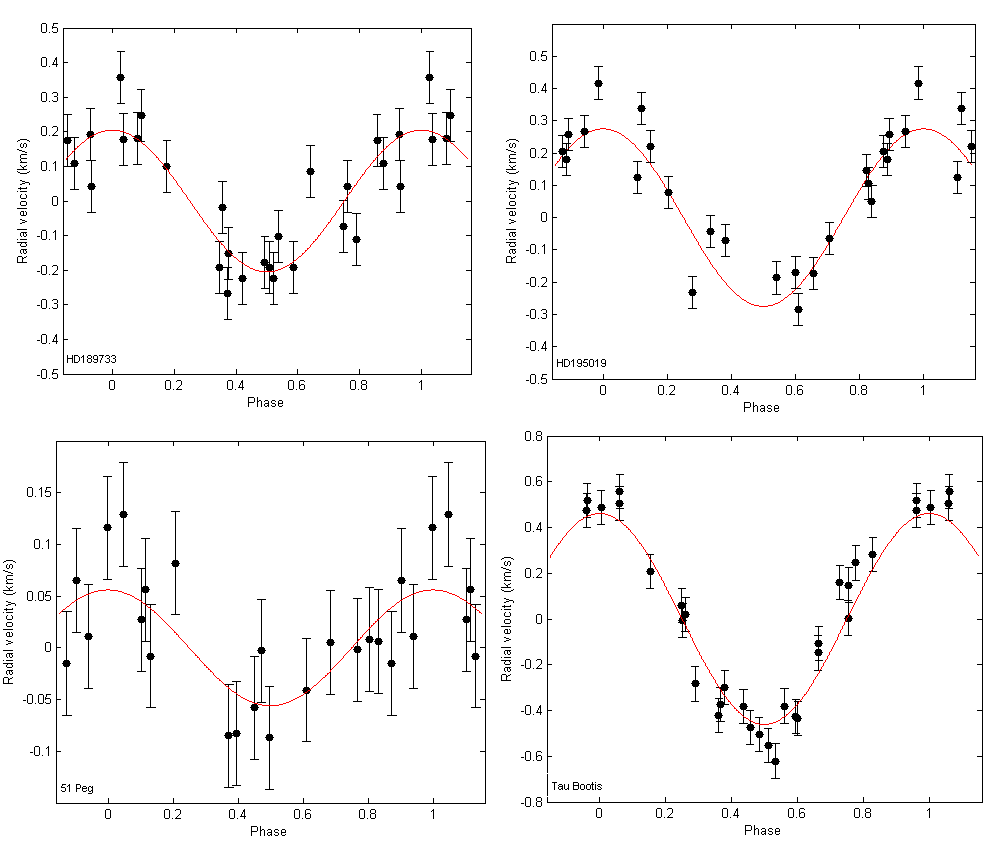
stability of 50 m/s for the eShel . This is however consistent with the
uncertainties Buil et al found when measuring the RV of a number of stars
hosting exoplanets.
Once you try to measure RV to a precision better than 1km/s though, the
stability of the spectrograph as measured using the calibration lamp is only
one of the issues. For example the slit spectrograph is at a severe
disadvantage compared with the fibre feed version as the precise measured
location of the line in the star spectrum depends critically on the exact
position of the target on the slit. Even a shift of a fraction of a pixel
can (and does) produce significant errors as documented recently here for
example.
http://spectro-aras.com/forum/viewtopic ... 5692#p5637
Cheers
Robin
-----Original Message-----
From: Thomas Eversberg
Sent: Friday, September 23, 2016 1:39 PM
To:
fg-spek-admin@vdsastro.de
Subject: [fg spektroskopie] Re: New Echelle article
Link zum neuen Beitrag:
http://forum.vdsastro.de/viewtopic.php?t=4479#p28115
Hi Robin!
Zitat:
A skilled observer who understands the limitations of the
instrument and how to minimise their impact will do significantly
better in
practise though as I have found from personal experience with the
LHIRES
which has similar stability problems to those of the BACHES.
That is probably all correct. The more you invest above the basic
design the better are the results (until a certain physical threshold).
However, that are influences one can not measure and that are efforts
above the initial design and price. I mean, we can fully re-design
BACHES, LHIRES etc. But that would be no off-the-shelf instruments
anymore. Better is to test the manufacturers claims and compare them
with other instruments. If we blow-up such tests (optical efficiency,
potential user improvements etc.) we might confuse ourself and obtain
any result without really testing the initial instrument (if we then
can test it at all). I believe this is not a good strategy.
I hope that my paper is also a motivation for other instrument tests.
Otherwise we fully depend on the manufacturers information and pay a
lot for nothing.
Cheers, Thomas
 Registrieren
 Anmelden
 FAQ
FAQ Suche
Suche