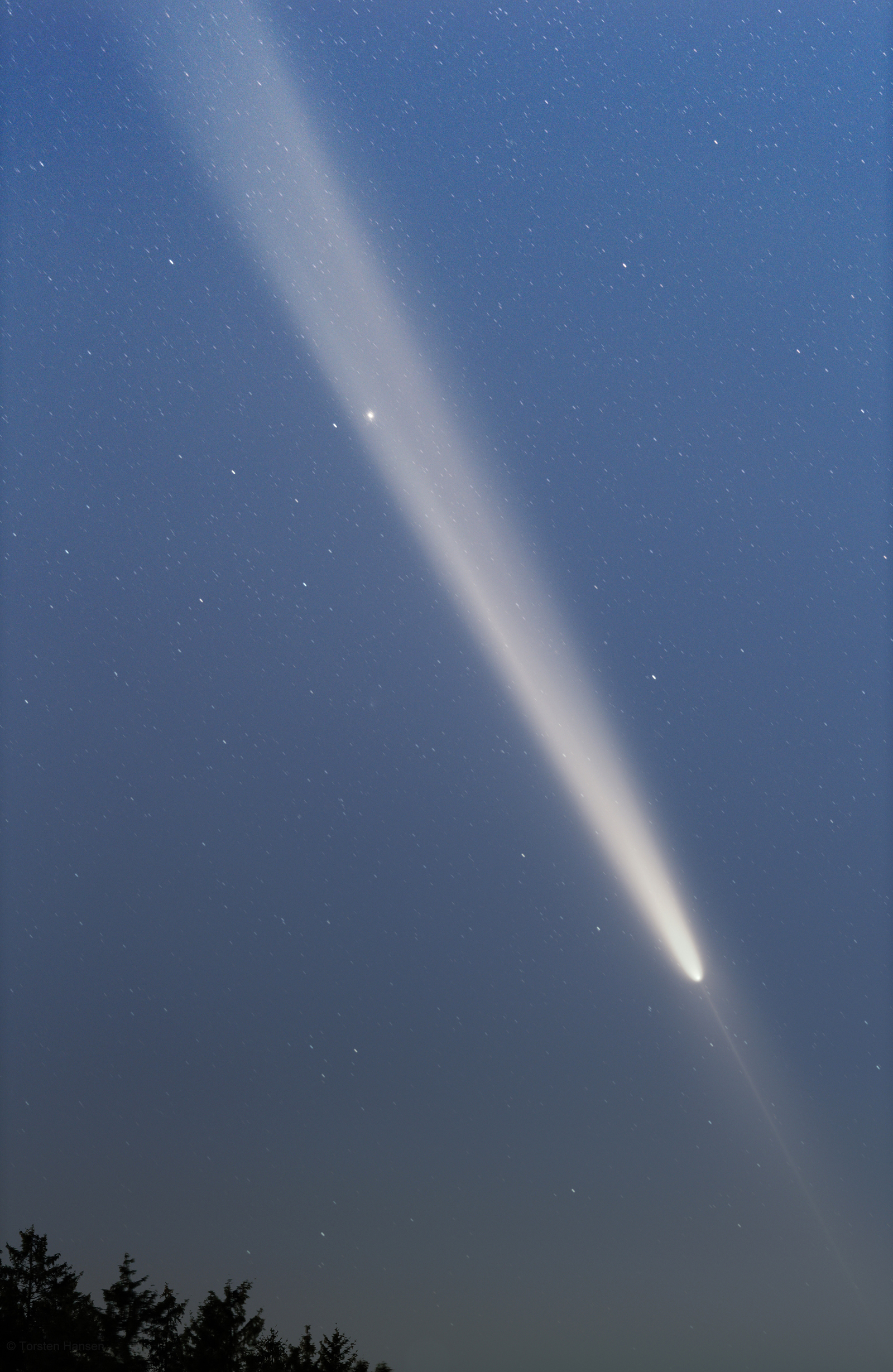
Liebe Kometenfreunde,
der Effekt der Vorwärtsstreuung ist ja in der Lichtkurve gut zu sehen. Je nachdem, wie sehr man einem einzelnen sehr hohen Messwert glauben darf, waren es 2-3 mag zusätzlich.
Dan Green äußert sich in cbet 5468 ausführlich dazu. Die leicht gekürzte, [kommentierte] Übersetzung:
Auf Grund Joseph' Marcus Vorhersage (
CBET 5445, Theorie
hier) zur Vorwärtsstreuung [er war nicht der einzige], welche uns Anfang Oktober einen Helligkeitszuwach bescheren sollte, versuchten mherere erfahren Beobachter, den Kometen zwischen dem 8. und 11. Oktober nahe der Sonne zu beobachten [ich auch], alles ohne Erfolg. Von einigen nicht verifizierten Fernglasbeobachtungen, die sonstwohing [COBS] geschickt wurden, erhielt das ICQ keine Nachricht. [Wären sie dann besser verifiziert gewesen? Dan ist wohl etwas verschnupft hier.]
Die negativen Ergebnisse lassen darauf schließen, dass der Komet im Maximum nicht viel heller als -2 mag gewesen ist. Das glt selbst dann, wenn wir annehmen, dass die Beobachter nur den inneren Teil der Koma gesehen haben.
Das ICQ bat die Soho-Spezialisten um Helligkeitsabschätzungen. Im LASCO C3 war der Helligkeitsanstieg durch Vorwärtsstreuung gut zu sehen. Q.-c. Zhang vom Lowell Observatorium gab für den 9. Oktober 10 h UT Helligkeiten von 2,9 mag mit 5' Apertur und -3,8 mag in 15' Apertur an. Gemäß Dan und Charles Morris hatte die Koma zu diesem Zeitpunkt etwa 7-10 Bogenminuten, wenn man als Koma das ansieht, was die visuellen Beobachter zur Helligkeitsbestimmung benutzen. Interpoliert ergibt das -3,1 mag visuell-ähnliche Komahelligkeit. Das stimmt damit überein, dass der Komet visuell nicht gefunden wurde [stimmt nicht ganz, in COBS gibt es etwas] und stimmt überein mit dem -2-mag-Limit der inneren Koma, welchem die Visuellen ausgesetzt waren.
[Ende des Zitats, englisches Original liegt bei.]
ich gebe hier noch die COBS-Daten aus diesem Zeitpunkt an:
Code:
2024 10 11.74  I -1.0:-   8.0B    15   7    7            DES02  DES02
2024 10 11.74  S -1.5 TK  8.0B    20   7    7            GON06  GON06
2024 10 11.74  I -2.0 TK  7.0B    10        5            ICQ XX DEC
2024 10 11.74  S  1.5 TK  5.0B    10        6            ICQ XX VAN16
2024 10 11.73  S -0.5:AE  6.3B     9 &10    8            ICQ XX KAM01
2024 10 10.33  I -2.5 -   8.0B        20                 XIO    XIO
2024 10 08.13  I -1.8:-   8.0B                           XIO    XIO
Kommentare der Beobachter:
2024 10 11.74 DES02 Peter De Schrijver; Location: Beert; Comment: Just a rough estimation, no time for any comparison at all, except Venus, since the comet was only 2 degrees above the horizon and dissapearing within minutes behind some low clouds.;
Zitat:
2024 10 11.74 GON06 Virgilio Gonano; Location: Udine, Italy;
2024 10 11.74 DEC Michel Deconinck; Location: Artignosc-sur-Verdon, Provence, France; RefStars: Venus and Arcturus;
2024 10 11.74 VAN16 David Vansteelant; Location: Bruges;
2024 10 11.73 KAM01 Andreas Kammerer; Location: Voelkersbach (Black Forest), Germany; SQMethod: NELM; SQValue: -1.0; Comment: Comet altitude 2 deg (Sun: -9deg): Comet first seen after it departed the lower border of a larger cloud cover: nebular object with central condensation. Brightness estimate very rough, Comet compared with Venus (at the same altitude).;
2024 10 10.33 XIO Jiarui Xiong; Location: Ocean University of China; Comment: Observing through a pair of 20x80 binoculars under general daytime conditions, a very challenging target took 15 minutes to confirm its position, which was later found to match the star map. I guess the comet's brightness is between -2 and -3.5 magnitude.;
2024 10 08.13 XIO Jiarui Xiong; Location: Ocean University of China; RefStars: Mercury; Comment: Observing with 20x80 binoculars during the daytime, the comet appears as an indistinct small patch, barely visible, with no details discernible.;
Von unserer Fachgruppe war Andreas Kammerer erfolgreich, Glückwunsch! Im Rahmen der kritischen Beobachtungsbedingungen sehe ich die Werte als recht konsistent an. Allerdings hat auch Dan recht: Die Maximalghelligkeit lag nicht über ca. -2 mag. Nur eine Messung liegt darüber, diejenige vom 10. Oktober aus China mit hoher Unsicherheit: Jiarui Xiong gibt im Kommentar den Bereich von -2 bis -3,5 mag an.
Hier noch der originale Ausschnit aus cbet 5468:
Zitat:
Following J. N. Marcus' prediction (CBET 5445) that comet C/2023 A3
might exhibit some significant forward-scattering brightness enhancement
as seen from the earth when the comet was at very small solar elongations in
the first part of October, several experienced observers worldwide tried
visually to observe the comet when the comet was within 7 degrees of the sun
during Oct. 8-11, without success. (A couple of unverified visual binocular
sightings with limited information that were posted elsewhere have not been
sent to the Central Bureau or the ICQ.) The negative reports suggest that
the comet was unlikely to have been much brighter than total visual mag -2
at peak, given that visual observers would only have seen perhaps the inner
coma with diameter perhaps 2'-3'. However, significant brightening was seen
in SOHO LASCO C3 coronagraph images when the comet was in the field-of-view,
supporting Marcus' calculations generally. The Central Bureau asked the
SOHO-satellite comet specialists for their assessment of the comet's peak
brightness in the LASCO C3 coronagraph images. Q.-c. Zhang (Lowell
Observatory) responded with measurements of total mag -2.9 in a 5' aperture
and -3.8 within a 15' aperture centered on the comet's nuclear condensation
on 2024 Oct. 9.40 UT, calibrated to Johnson V with comparison star 39 Tau.
As interpreted by C. S. Morris and the undersigned, the diagram supplied by
Zhang with circular apertures superimposed on the comet's head and inner
tail suggests that roughly 7'-10' would be the size of the coma for a
traditional total magnitude of the comet, yielding perhaps total mag -3.1 to
-3.2 for a peak brightness. This would be consistent with the visual
observers not finding the comet, with a brightness of perhaps -2 for the
inner 2'-3' of coma that would have been detected visually. Zhang measured
the brightness for the 1' diameter centered on the nuclear condensation on
Oct. 9.40 to be -1.3 (V band, calibrated against Vega). Note that brightness
measurements of SOHO images larger than 10' would include a large part of
the tail that is not conventionally taken as part of the total magnitude.
 Registrieren
 Anmelden
 FAQ
FAQ Suche
Suche



 Arizona