| Forum der Vereinigung der Sternfreunde https://forum.vdsastro.de/ |
|
| Nachthimmelsspektrum https://forum.vdsastro.de/viewtopic.php?t=130 |
Seite 1 von 1 |
| Autor: | Gerd Neumann [ 17. Januar 2007, 12:47:49 PM ] | ||
| Betreff des Beitrags: | Nachthimmelsspektrum | ||
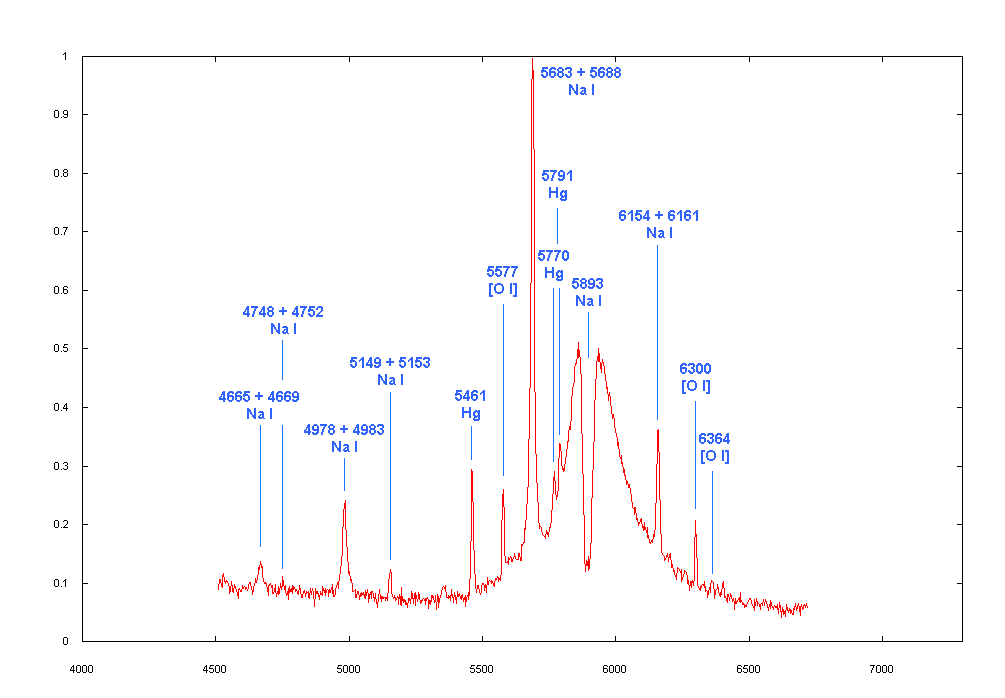
Hallo Liste, anbei ein Nachthimmelsspektrum aus Münster, aufgenommen mit einer Canon EOS 350D. Kann mir jemand von Euch die Linien zuordnen? Hat jemand von Euch eventuell ein schönes Spektrum einer HPS Lampe? Viele Grüße Gerd
|
|||
| Autor: | Peter Stoffer [ 17. Januar 2007, 17:03:31 PM ] |
| Betreff des Beitrags: | |
Das Thema wurde verschoben nach "Beobachtungen | Observations" (fg-spek-obs@fg-vds.de). Peter Stoffer |
|
| Autor: | Andreas Ulrich [ 17. Januar 2007, 17:54:41 PM ] |
| Betreff des Beitrags: | Nachthimmelsspektrum |
Lieber Herr Neumann, das Nachthimmelspektrum ist interessant. Ich denke, dass ich morgen Zeit haben werde, eine Zuordnung zu versuchen. Gibt es denn schon in etwa eine Wellenlängenkalibrierung des Spektrometers? Gitter oder Prisma? Können die beiden gelben Linien Na D sein? Scheinen mir dafür evtl. ein wenig zu gut getrennt, in Anbetracht des großen Spektralbereiches. Wenn HPS "high pressure sodium" ist, kann ich sicher mit unserem mobilen "Ocean Optics" eine passende Straßenlampe finden. Quecksilber- Hochdrucklampenspektren habe ich. War denn der Himmel recht aufgehellt? Großer Raumwinkel beobachtet? Je mehr natürlicher Nachthimmel dabei ist, umso interessanter wäre dies. Z.B. ob die grünen und roten Linien evtl. von den verbotenen N und O Übergängen stammen? Ob das Kontinuum z.T. von räumlich unaufgelösten Sternen stammt - oder einfach nur terrestrische Glühbirnen? Mit vielen Grüßen, Andreas Ulrich. |
|
| Autor: | Wolfgang Renz [ 18. Januar 2007, 02:18:18 AM ] | |||||
| Betreff des Beitrags: | Nachthimmelsspektrum | |||||
Zitat: Kann mir jemand von Euch die Linien zuordnen?
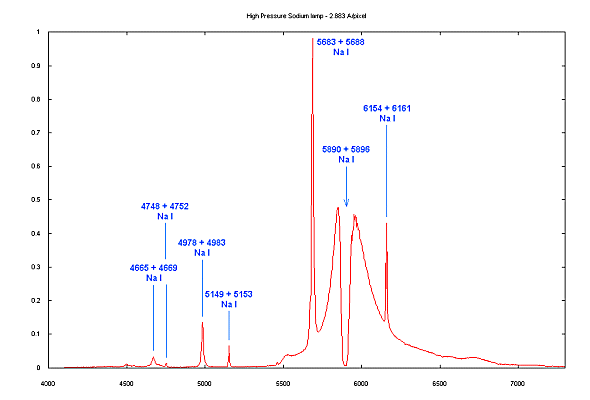
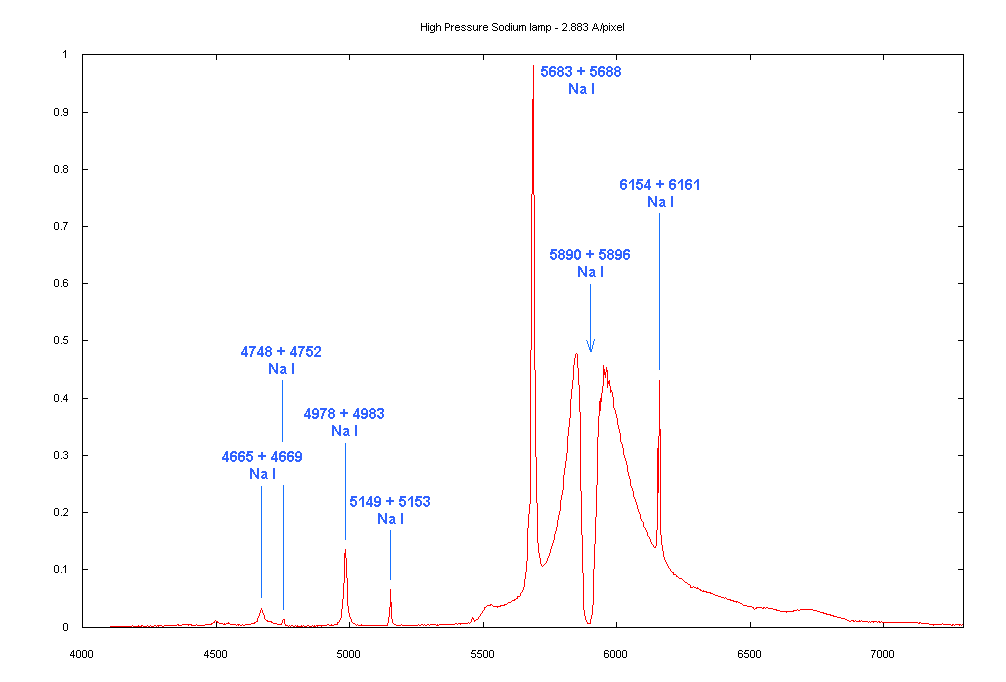
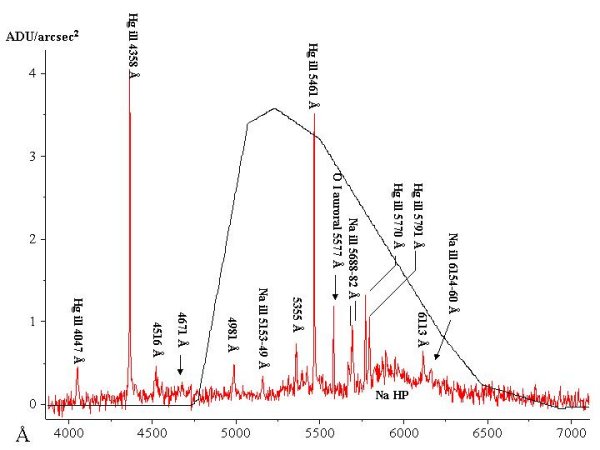
- SBIG DSS Spectrographhttp://www.sbig.com/dss7/dss7.htm Figure Eleven: Skyglow Spectra from Two Sites http://www.sbig.com/dss7/image028a.gif Figure Twelve: Absolute Bright and Dark Sky Brightness http://www.sbig.com/dss7/image030a.gif - JCE 1997 (74) 1070 [Sep] Challenges of Everyday Spectra http://pubs.acs.org/doi/abs/10.1021/ed074p1070 Figure 1: Common night lamp spectra a Incandescent, b Fluorescent, c LP Hg, d HP Hg, e Metal halide, f HP Na, g LP Na, h Neon sign red, i Neon sign other colors. - Gary Schmidt - SPOL CCD Imaging/Spectropolarimeter http://james.as.arizona.edu/~psmith/SPOL/ Section: Calibration lamp spectra (600 g per mm grating) Typical Kitt Peak night-sky spectrum 400-750 nm http://james.as.arizona.edu/~psmith/SPOL/lamps/sky.jpg - The Spectrum of the Night Sky over Mount Hopkins and Kitt Peak - Massey & Foltz.gif (2000 PASP, 112: 566-573) http://adsabs.harvard.edu/abs/2000PASP..112..566M http://www-kpno.kpno.noao.edu/mtninfo/m ... z_2000.pdf Zitat: Hat jemand von Euch eventuell ein schönes Spektrum einer HPS Lampe?
- Emissionsspektren von Na & Hg Hochdrucklampen.jpg- Christian Buil - Spectral calibration - Sky light pollution High Pressure Sodium lamp types (Castanet Tolosan - France).gif http://www.astrosurf.com/buil/us/spe2/hresol4.htm sky light pollution - telescope is pointed toward a far street lamp: http://www.astrosurf.com/buil/us/spe2/c ... burb_2.gif (klein) http://www.astrosurf.com/buil/us/spe2/c ... burb_1.gif (groß) sky spectrum at Castanet Tolosan http://www.astrosurf.com/buil/us/spe2/calib2/sky_2.gif (klein) http://www.astrosurf.com/buil/us/spe2/calib2/sky.gif (groß) Clear skies Wolfgang -- Wolfgang Renz, Karlsruhe, Germany Rz.BAV = WRe.vsnet = RWG.AAVSO
|
||||||
| Autor: | Wolfgang Renz [ 18. Januar 2007, 02:27:40 AM ] |
| Betreff des Beitrags: | Nachthimmelsspektrum |
siehe unten: Clear skies Wolfgang -- Wolfgang Renz, Karlsruhe, Germany Rz.BAV = WRe.vsnet = RWG.AAVSO http://mira.aavso.org/pipermail/aavso-p ... 02207.html [Aavso-photometry] Low-pressure sodium lights and photometry Wolfgang Renz w_renz at ... Sun Feb 26 13:52:54 EST 2006 Hello Bob Zitat: I'm an astronomer at Ohio Wesleyan University, which is about 20
The large reflector could be used for photometry too. You just wouldmiles north of Columbus. OWU owns and operates Perkins Observatory (www.perkins-observatory.org), which houses a 32-inch reflector. Because it's f/17, it's not very useful for CCD photometry as the field of view is about 3x2 arcmin with our SBIG ST-8E. Thus, the telescope is used mostly for visual observing by students and the many visitors to our twice-weekly public programs. However, I do use 8-inch and 12-inch telescope on site for BVRI photometry. have to select your targets appropriatly. With such a small FOV and a good tracking/guiding mount you could e.g. concentrate variables with close companions, variables in globular or smaller open clusters etc. Zitat: To make a long story short, there is a strong possibility that a Wal-
If the major light pollution source are the LPS lights, any broad bandMart Supercenter and a Toyota dealership will be built within a mile of the observatory to the south. The good news is that both would be on land annexed by the city (pop. ~22,000) in which OWU is located (the observatory is on the outskirts of town) and thus subject to lighting code restrictions which would require them to use low-pressure sodium lamps on 28-foot poles, as opposed to typical broad-spectrum parking lot lights on 40-foot poles. (Wait until the Toyota dealer sees what his cars look like under LPS light!) The bad news, of course, is that the lovely yellow glow will still most likely annihilate the naked-eye views from the observatory grounds and degrade telescopic views of objects like galaxies and clusters. LPR filter that rejects the 588 nm Na emission line will help to supress their light output. Getting rid of HPS light output, that converts the 588 nm Na emission line to a much broader emission around 588 nm and other wavelengths is much more difficult (even the IDAS LPR isn't ideal for this purpose). See: Micheal Koppelmann - High-Pressure Sodium Vapor Lamp Spectrum http://www.lolife.com/astronomy/na.jpg Christian Buil - Spectral calibration - Sky light pollution High Pressure Sodium lamp types (Castanet Tolosan - France) http://www.astrosurf.com/buil/us/spe2/hresol4.htm http://www.astrosurf.com/buil/us/spe2/c ... burb_1.gif http://www.astrosurf.com/buil/us/spe2/calib2/sky.gif http://www.astrosurf.org/buil/filters/sodium.png (HPS!) http://www.astrosurf.org/buil/filters/sodium_1.jpg (HPS!) SCHIAPARELLI OBSERVATORY - Light Pollution Light Pollution at Campo dei Fiori Observatory http://www.astrogeo.va.it/astronom/spet ... _lumen.htm http://www.astrogeo.va.it/astronom/spet ... nq_lum.jpg SBIG - DSS-7 Deep Space Spectrograph http://www.sbig.com/dss7/dss7.htm http://www.sbig.com/dss7/image028a.gif http://www.sbig.com/dss7/image030a.gif ... Christian Buil - Astronomical filter curves (LPR) http://www.astrosurf.org/buil/filters/c ... ON%20POWER Don Goldman - Light Pollution Filters http://www.astrodon.com/oldsite/LPSFilters.html Hutech Astronomical Products - IDAS Light Pollution Suppression Filters, Limitations and Common Misconceptions http://www.sciencecenter.net/hutech/idas/lps2.htm Ron Wodaski - Evaluation of Hutech IDAS light pollution suppression filters http://www.wodaski.com/wodaski/IDAS_review.htm Zitat: I have two questions for the list. Any insight would be greatly
LPS lights has a single major emission line at 588 nm and thereforeappreciated! 1. It seems to me that LPS lights should have a minimal effect on BRI photometry, but that V might be a different story. Am I correct in my thinking? Has anybody succeeded in doing good V-filter photometry in the presence of strong LPS skyglow? Any tips? should show up in the images of the photometric V AND Rc band filters about equally (at ~ 50-70% of the max transmission of the filters). For photometry the usage of LPR filters is of course not allowed. As with any imaging under light polluted skies, you'll need to make longer exposures to reach the same SNR for photometry. With using the linear CCDs the effects of light pollution can be handeld much better (even without a LPR filter) than with the non-linear film or visually. See e.g.: Jay R. Ballauer - Does Light Pollution Affect CCDs http://www.allaboutastro.com/Articlepag ... tCCDs.html Robert Bateman - LPR Problem, The effects of an LPR on a large scope http://www.robertb.darkhorizons.org/lpr.htm Christian Buil - Urban astronomical observations (LPR filters evaluation, spectroscopy, ...) http://www.astrosurf.org/buil/city/result.htm Tony Flanders - Aperture versus Light Pollution http://mysite.verizon.net/vze55p46/id1.html Zitat: 2. Does anybody know of references for estimating the level of skyglow
I don't know references for estimates as they depend probably on toofrom a given number of LPS lights at given wattages from a given distance? It would certainly help me make my case more effectively in community meetings if I could give some quantitative estimates of how bright the skyglow will be. Alternatively, does anybody know of any photos showing skyglow from LPS lights at a single large parking lot from a mile or a few miles away? There aren't any comparable facilities in my area. many factors. But there are a number of sites that have images with obvious light pollution. http://www.darksky.org/ http://www.astrosurf.com/re/light.html http://dipastro.pd.astro.it/cinzano/en/index.html http://dipastro.astro.unipd.it/cinzano/en/sbeam.html http://dipastro.astro.unipd.it/cinzano/papers.html http://cfa-www.harvard.edu/cfa/ps/nelpag.html ... Sky and Telescope - Secrets of Deep-Sky Observing By Alan M. MacRobert http://skyandtelescope.com/howto/visual ... e_78_2.asp http://skyandtelescope.com/resources/darksky/ Hutech Astronomical Products - IDAS Light Pollution Suppression Filters http://www.sciencecenter.net/hutech/idas/lps.htm http://www.sciencecenter.net/hutech/idas/lps1.htm http://www.sciencecenter.net/hutech/idas/lps3.htm http://www.sciencecenter.net/hutech/idas/tanaka.htm Clear skies Wolfgang -- Wolfgang Renz, Karlsruhe, Germany Rz.BAV = WRe.vsnet = RWG.AAVSO |
|
| Autor: | Gerd Neumann [ 18. Januar 2007, 11:26:58 AM ] |
| Betreff des Beitrags: | Nachthimmelsspektrum |
Hallo Herr Ulrich, das Spektrum wurde mit einem Gitterspektrographen aufgenommen, eine Wellenlängenkalibrierung gibt es leider noch nicht. Die beiden gelben Linien sind mit Sicherheit nicht die beiden Natrium Linien, die haben nur 1nm Abstand und sind bei der Auflösung noch nicht zu trennen. Das Spektrum wurde bei bedecktem Himmel aufgenommen um die Lichtverschmutzung zu dokumentieren. Dazu wurde der Spektrograph einfach mit dem Spalt Richtung Himmel in ca 45° Höhe ausgerichtet und 10min belichtet. (Das Kontinuum sind also die vielen Glühlampen.) Es wäre sehr hilfreich, wenn Sie mit Ihrem Spektrographen ein paar Wellenlängenkalibrierte Spektren aufnehmen und mir mailen könnten! Viele Grüße aus Münster Gerd Neumann |
|
| Autor: | Dieter Goretzki [ 19. Januar 2007, 17:55:47 PM ] |
| Betreff des Beitrags: | Nachthimmelsspektrum |
Gerd Neumann schrieb: Zitat: Hallo Herr Ulrich, das Spektrum wurde mit einem Gitterspektrographen aufgenommen, eine Wellenlängenkalibrierung gibt es leider noch nicht. Die beiden gelben Linien sind mit Sicherheit nicht die beiden Natrium Linien, die haben nur 1nm Abstand und sind bei der Auflösung noch nicht zu trennen.
Hallo Herr Neumann, die beiden gelben Linien sind wahrscheinlich Hg-Linien bei 579,066 und 576,960 nm. Die starke grüne Linie vermutlich Hg 546,074 nm oder Hg 491,604 nm. Viele Grüße Dieter |
|
| Autor: | Andreas Ulrich [ 22. Januar 2007, 14:40:06 PM ] | ||||||
| Betreff des Beitrags: | Nachthimmelsspektrum | ||||||
Lieber Herr Neumann, nachdem es sich ja um künstliche Quellen handelt, ich habe mal in meinen Katalogen nachgesehen (OSRAM). Da gibt es die HQL un HQI Lampen, die für Verkehrs- und werkhallenbeleuchtung verkauft werden, bis 400 W. Es sind nur grobe Spektren gezeigt. Ich füge sie mal bei. Für Hg Niederdruck habe ich bei einer Art Seminar mal Spektren aufgenommen. Ich schicke sie mit evtl. hilft das beim Wellenlängenkalibrieren. Ich fände es interessant, mal den natürlichen Hintergrund zu studieren (Na- Schicht, mit der die "Nachführsterne" in der adaptiven optik gemacht werden. Ob das auch sonst angeregt wird? Die Auroralinien? Zodiakallicht? etc.) Mit vielen Grüßen, Andreas Ulrich
|
|||||||
| Autor: | E.H.Geyer [ 22. Januar 2007, 15:01:47 PM ] |
| Betreff des Beitrags: | Nachthimmelsspektrum - Literatur. |
Zitat: Hallo Liste, anbei ein Nachthimmelsspektrum aus Münster, aufgenommen mit einer Canon EOS 350D. Kann mir jemand von Euch die Linien zuordnen? Hat jemand von Euch eventuell ein schönes Spektrum einer HPS Lampe? Viele Grüße Gerd
Sehr geehrter Herr Neumann, in bezug auf Ihr schönes Nachthimmelspektrum möchte ich Sie auf zwei Bücher verweisen: F.E. Roach & J.L. Gordon, 1973:´The Light of the Night Sky´, Reidel Publishing Co. Dordrech-Holland. A. Meinel, A. Aveni & M. Stockton, 1969, `Catalog of Emission Lines in Astrophysical Objects´, Tucson, University of Arizona. In diesem Katalog sind neben den `Airglow´-(zumeist hochatmosphärische Molekülbandenlinien O2, N I, NI, N 2, OH), die `Aurora´- und `Gewitter-Blitzlinien aufgeführt, wie auch die `City Lights´-Linien. Vor vielen Jahren habe ich mir die Mühe gemacht und die Identifizierung der aufgeführten Linien vorgenommen und sie mir Bleistifft angeschrieben. In wie weit sich diese Anmerkunken herauskopieren lassen kann ich nicht sagen. Mit freundlichen Grüssen Edward H. Geyer. |
|
| Seite 1 von 1 | Alle Zeiten sind UTC+02:00 |
| Powered by phpBB® Forum Software © phpBB Limited https://www.phpbb.com/ |
|