| Forum der Vereinigung der Sternfreunde https://forum.vdsastro.de/ |
|
| P Cygni https://forum.vdsastro.de/viewtopic.php?t=2709 |
Seite 1 von 1 |
| Autor: | Ernst Pollmann [ 04. Dezember 2008, 16:38:03 PM ] | ||
| Betreff des Beitrags: | P Cygni | ||
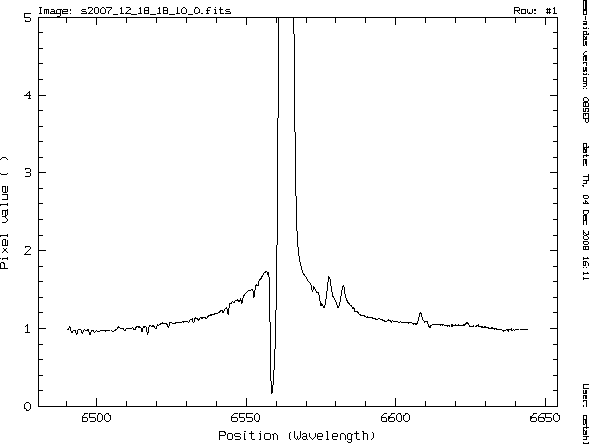
Dear project partners, our friend Mitsugu Fujii from Japan has taken a very important spectrum of P Cygni. Very important, because during the last months, observers in Europe due to the very bad weather were not able to take spectra. In the attached plot you can find the current status. Thank you Mitsugu!! Best wishes, yours Ernst Pollmann Germany http://www.astrospectroscopy.de
|
|||
| Autor: | Otmar Stahl [ 04. Dezember 2008, 17:30:12 PM ] | ||
| Betreff des Beitrags: | P Cygni | ||
Hello P Cygni observers, Ernst Pollmann wrote: Zitat:
Dear project partners,
This is an impressive collection of data! Unfortunately, the x-axis is our friend Mitsugu Fujii from Japan has taken a very important spectrum of P Cygni. Very important, because during the last months, observers in Europe due to the very bad weather were not able to take spectra. In the attached plot you can find the current status. very compressed. Therefore it is difficult to see, what is happening on shorter time scales. My first impression is, however, that the error bars are too optimistic: P Cygni has *very* broad emission line wings. This means, that the integration range in wavelengths has to be very large in order to measure a reliable equivalent width. Therefore, the following is required for a good measurement of the equivalent width: 1) The wavelength range covered by the spectrograph should be significantly larger than the wavelength range measured for the equivalent width. In this case, an estimate of the non-linearity of the continuum is possible. 2) The continuum should be very flat or vary only linearly with wavelength. Otherwise you do not know what the continuum is doing between the integration limits. Because of the wide wings, normalization requires significant interpolation. In any case, a good error estimate is very difficult for the Halpha line of P Cygni. How was the error estimated and did all observer use similar procedures? In my opinion, a 10% error is already quite good, at least, when results from different observers are compared. As an example I enclose a spectrum taken by Lothar Schanne. The wings cover almost the full spectral range. From my spectral atlas, I can trace the line wings from about 6500 to 6630 A: http://www.lsw.uni-heidelberg.de/users/ostahl/pcyg/ When you do not know where the continuum is, the error of the equivalent width is a almost undefined. You can only *assume* that the continuum is linear. My recommendation would be to use another, less problematic, spectral line. Best regards, Otmar
|
|||
| Autor: | Ernst Pollmann [ 10. Dezember 2008, 19:19:21 PM ] | ||
| Betreff des Beitrags: | P Cygni | ||
Dear project partners, I will try to inform you as regularly as possible about the progress of our common P Cyg project. Actually there are new measurement both, in Halpha equivalent width and in V. The attached plot shows the current situation. My feeling is, that we see first indication of the anti-correlation (found by N. Markova) between this parameters. Unfortunately the amateurs in Europe have been not able to take more spectra because of the bad climate situation. Additionally the visibility of star is going soon to the end. But it seems that we can be optimistic, to find interesting results in the future, if we collect further continuously our data. Thank you all for your data contribution, merry christmas and a happy new year, Ernst ---------------------------------------------- In German: Liebe Projekpartner, ich will versuchen, regelmäßig über den Verlauf unseres gemeinsamen PCygni-Projektes zu informieren. Momentan gibt es neue Messungen in der Halpha EW wie auch in V. Der angehängte Plot zeigt die gegenwärtige Situation. Meiner Meinung nach sind erste Anzeichen der Anti-Korrelation (wie von N. Markova nachgewiesen) erkennbar. Leider sind die Amateurspektroskopiker in Europa wegen des schlechten Wetters nicht in der Lage gewesen, Spektren mit einer höheren Häufigkeit aufzunehmen. Ausserdem geht in bälde die Sichtbarkeit des Stern dem Ende entgegen. Doch es scheint, dass wir optimistisch sein können, in Zukunft ein interessantes Beobachtungsergebnis zu erhalten. ----------------------------------------------- Best wishes, yours Ernst Pollmann Germany http://www.astrospectroscopy.de ------
|
|||
| Seite 1 von 1 | Alle Zeiten sind UTC+02:00 |
| Powered by phpBB® Forum Software © phpBB Limited https://www.phpbb.com/ |
|