Hello,
Mintaka from Saturday exposure with 30 minutes! He 6678 is unfortunately outside the area but the next time should fit better.
greetigs
Siegfried
| Dateianhänge: |
|
mintaka.gif [ 22.91 KiB | 33777 mal betrachtet ] |
| Forum der Vereinigung der Sternfreunde https://forum.vdsastro.de/ |
|
| Request for observations of the 2mag star delta Orionis https://forum.vdsastro.de/viewtopic.php?t=3877 |
Seite 1 von 4 |
| Autor: | Thomas Eversberg [ 27. September 2012, 14:06:39 PM ] | ||
| Betreff des Beitrags: | Request for observations of the 2mag star delta Orionis | ||
Hi together! Prof. Anthony Moffat from Université de Montréal asks for support observations of the 2mag star delta Orionis (Mintaka). Ground based amateur and professional observations will support already allocated observation time for the space telescopes Chandra (X-ray) and MOST (photometry) in December/January. Attached you will find the respective request. The required output parameters (R > 10.000, S/N > 200 within 30 minutes) should be possible for a large number of amateur observers. Note that Tony (he is also the PI of our WR campaign in 2013) also asks for respective photometric observations. I want to point out that each useful data contribution will result in co-authorship in the ensuing refereed publication. Cheers, Thomas
|
|||
| Autor: | Hold Siegfried [ 05. Oktober 2012, 19:11:57 PM ] |
| Betreff des Beitrags: | |
Hello Thomas, I'm with you. The requirements are to be achieved well with my equipment. The fog could be a problem this time of year! cheers Siegfried |
|
| Autor: | Thomas Eversberg [ 06. Oktober 2012, 09:02:22 AM ] |
| Betreff des Beitrags: | |
Great Siegfried! Don't forget to inform Tony Moffat. He is in charge. Cherio, Thomas |
|
| Autor: | Hold Siegfried [ 19. November 2012, 22:02:53 PM ] | ||
| Betreff des Beitrags: | |||
Hello, Mintaka from Saturday exposure with 30 minutes! He 6678 is unfortunately outside the area but the next time should fit better. greetigs Siegfried
|
|||
| Autor: | Bernard Heathcote [ 29. November 2012, 04:07:21 AM ] | ||
| Betreff des Beitrags: | |||
I made a couple of tests this week to see which is my best option for obtaining del Ori spectra and the results are shown below. The first test was with a Lhires with 1800 grating on a C11 with an Atik 314L+ CCD. After telluric line removel (using a synthetic H2O profile) and continuum removal the S/N=260. As R=12,000 this setup meets the campaign requirements for S/N, R and the the basic H-alpha 6263 and HeI 6678 requirements. The second test, with a fibre-fed echelle (shown in red, after telluric line removal) on a C14, doesn't meet a campaign requirement, with S/N=73 only. This is despite using a larger scope, so the poorer performance is probably due to fibre losses. So the trade-off is broad spectrum coverage with a lower noise or a narrow band spectra with low noise. Cheers, Bernard
|
|||
| Autor: | Robin Leadbeater [ 29. November 2012, 14:48:34 PM ] |
| Betreff des Beitrags: | |
Hi Bernard, Wow that is a big loss. (73/260)^2 x (11/14)^2 = ~5% I dont think that much difference between LHIRES and eShel is normal. Cheers Robin |
|
| Autor: | Bernard Heathcote [ 29. November 2012, 15:16:52 PM ] |
| Betreff des Beitrags: | |
Hi Robin, I fully agree with you and this large discrepancy has been a concern since I've had the eShel. I was about to contact Christian on this problem, using the del Ori data as an example, but would be interested to hear from any other eShel owners on this. One possible explanation, which I've not yet checked, it that there may be a poor fibre cable connection (I've already had to replace one due to breakage). One indicator that the link may be the reason is that my calibrations require longer exposures (for a given SNR) than the norm. Any other possible suggestions welcome, from all. Cheers, Bernard |
|
| Autor: | Christian Netzel [ 29. November 2012, 15:34:39 PM ] |
| Betreff des Beitrags: | |
Zitat:
The second test, with a fibre-fed echelle (shown in red, after telluric line removal) on a C14, doesn't meet a campaign requirement, with S/N=73 only. This is despite using a larger scope, so the poorer performance is probably due to fibre losses. So the trade-off is broad spectrum coverage with a lower noise or a narrow band spectra with low noise.
Hi Bernard,Cheers, Bernard can you exclude autoguiding problems as an additional reason? It is much more difficult to keep the star at the small entrance of a fibre than on a long slit. What kind of fibre is used by your echelle, single or multimode? Cheers Christian |
|
| Autor: | thierry Garrel [ 29. November 2012, 17:29:49 PM ] |
| Betreff des Beitrags: | Request for observations of the 2mag star delta Orionis |
Hi Bernard,Robin is right the difference cannot be a fiber loss. Fiber feed spectroscope are less efficent than a slit spectrograph but not so. If we consider only hardware problem here are some tracks to help you: -Check you F ratio, it is better to be at f4 to f5, best fit with eshell f ratio and it can compense the fiber loss. -You said that it take more exposure time for calibration lamp then you may have two problems: Fiber injury. Check with a brand new one. Or misalignment of the hole in the guiding mirror with the fiber head. It is very common, you can loose easely 2/3 of the flux without loosing signal. I used to check it first when i have a poorest signal. The procedure is undocumented but i can explained it to you. I have a snr of 250 on gam cas in 30mm, with a st10 and a C14 under optimal conditions. Well you cannot check on this star and i didn't make any test on delta orionis. I will give a try this week end for comparing both result but these star are in same range of magnitude. Cheers thierry. 2012/11/29 Christian Netzel <fg-spek-convento@vds-astro.de (fg-spek-convento@vds-astro.de)> Zitat: Bernard Heathcote hat Folgendes geschrieben:
The second test, with a fibre-fed echelle (shown in red, after telluric line removal) on a C14, doesn't meet a campaign requirement, with S/N=73 only. This is despite using a larger scope, so the poorer performance is probably due to fibre losses. So the trade-off is broad spectrum coverage with a lower noise or a narrow band spectra with low noise. Cheers, Bernard Hi Bernard, can you exclude autoguiding problems as an additional reason? It is much more difficult to keep the star at the small entrance of a fibre than on a long slit. What kind of fibre is used by your echelle, single or multimode? Cheers Christian |
|
| Autor: | Tony Moffat [ 29. November 2012, 22:37:22 PM ] |
| Betreff des Beitrags: | Request for observations of the 2mag star delta Orionis |
Hi Bernard: The high S/N spectra look fine. Maybe you could shift the wavelength a bit, though, to include well both lines, H-alpha 6562 and HeI 6678. Great stuff! Tony From: Bernard Heathcote (fg-spek-convento@vds-astro.de) Sent: Wednesday, November 28, 2012 9:07 PM To: fg-spek-convento@vds-astro.de (fg-spek-convento@vds-astro.de) Subject: [fg-spek] Re: Request for observations of the 2mag star delta Orionis I made a couple of tests this week to see which is my best option for obtaining del Ori spectra and the results are shown below. The first test was with a Lhires with 1800 grating on a C11 with an Atik 314L+ CCD. After telluric line removel (using a synthetic H2O profile) and continuum removal the S/N=260. As R=12,000 this setup meets the campaign requirements for S/N, R and the the basic H-alpha 6263 and HeI 6678 requirements. The second test, with a fibre-fed echelle (shown in red, after telluric line removal) on a C14, doesn't meet a campaign requirement, with S/N=73 only. This is despite using a larger scope, so the poorer performance is probably due to fibre losses. So the trade-off is broad spectrum coverage with a lower noise or a narrow band spectra with low noise. Cheers, Bernard Quicquid Nitet Notandum |
|
| Autor: | Bernard Heathcote [ 29. November 2012, 23:35:03 PM ] |
| Betreff des Beitrags: | |
My responses to the last postings from Christian, Thierry and Tony: Christian, I am confident that autoguiding is not the problem and the fibres are multimode silica. Thierry, I agree that normal fibre losses are unlikely to be the problem and that an 'injury' might be the cause. Not so easy to check by swapping with a brand new Shelyak fibre as these are expensive and I don't have a spare. I do have a cheap (not armoured) Chinese fibre that I can check with. Thanks for the suggestion on the alignment testing. Based on guide camera FOV measurements I believe the FR is ok. I would be interested to see what results you can get with del Ori! Tony, I have already shifted the spectra to better include both H-alpha and the HeI lines but have been unable to make more tests due to our unstable weather ... we just had our hottest November day on record, which leads to stormy skies. If I can improve my echelle's performance I will make further tests with that setup. Cheers, Bernard |
|
| Autor: | Dong Li [ 30. November 2012, 07:07:08 AM ] |
| Betreff des Beitrags: | the selection of a grating |
Hi dear Mr. Heathcote: I want to use a 1800l grating,too. I have already browsed the Optometrics company in the section of gratings, and found that there are many different types of gratings, standard ruled, high resolution ruled, holographic etc.... I'd like to ask you which is the best for normal & universal use with my setup: C11+ Lhires3? Thanks in advance Dong Li |
|
| Autor: | Bernard Heathcote [ 30. November 2012, 09:17:52 AM ] |
| Betreff des Beitrags: | Request for observations of the 2mag star delta Orionis |
Hi Dong, If you are going to order only a grating (which assumes you have a spare grating drawer) then I suggest the high-res 1800 (500 blaze), 25x50, #3-7189 from Optometrics. If you don?t have a spare grating drawer then I think you should order the complete unit (grating + drawer) from Shelyak. Although this item is not listed on their website I am sure they will make a special order for you, which is what they did for me about four years ago. Cheers, Bernard From: Dong Li (fg-spek-convento@vds-astro.de) Sent: Friday, November 30, 2012 4:07 PM To: fg-spek-convento@vds-astro.de (fg-spek-convento@vds-astro.de) Subject: [fg-spek] Re: Request for observations of the 2mag star delta Orionis Hi dear Mr. Heathcote: I want to use a 1800l grating,too. I have already browsed the Optometrics company in the section of gratings, and found that there are many different types of gratings, standard ruled, high resolution ruled, holographic etc.... I'd like to ask you which is the best for normal & universal use with my setup: C11+ Lhires3? Thanks in advance Dong Li No virus found in this message. Checked by AVG - www.avg.com Version: 2013.0.2793 / Virus Database: 2634/5927 - Release Date: 11/29/12 |
|
| Autor: | Dong Li [ 30. November 2012, 10:20:25 AM ] |
| Betreff des Beitrags: | |
 Thank you very much dear Mr. Heathcote! Thank you very much dear Mr. Heathcote!I just find in China a grating-maker where they have 1800, and blaze at 500 and 540, and more to 720[to the IR range]. Usually we observe visually from 400~700, then I think that (400+700)/2=550, just take an average value. So I individually feel 540 is much better for normal use, don't I?  What is your suggestion? What is your suggestion? The 2nd confusion which I'd like to bother you is that if I order 300l, 150l gratings to use with my Lhires3, I want to know if this can take place the Star Analyzer? I use ETCL to simulate and get the spectral range is about from 400~700nm, almost the whole visual spectral band. Regards, Dong Li |
|
| Autor: | Berthold Stober [ 30. November 2012, 10:32:43 AM ] |
| Betreff des Beitrags: | |
Hello, perhaps you have seen my spectra of eps aur created with an eShel from shleyak you can download them. So you can compare my spectra with yours. Me too, I have had noumeres problems with the shelyak fibers. I sended it three(!) times to shelyak because the fiber was broken Then I used a fiber from "laser-components". This fiber never made any problems BUT the effeciency of this fiber seems me to be much worse then so shelyak fiber. If the alignment of the fiberinjection is ok, I do not know how I should test it. In any case this would be very sensitive........ cheers berthold |
|
| Autor: | thierry Garrel [ 30. November 2012, 11:34:02 AM ] |
| Betreff des Beitrags: | Request for observations of the 2mag star delta Orionis |
Well, a little bit off topic here.If no signal, the fiber is broken, if loss of signal may be a misalignment of the object fiber. Very common if you manipulate you injection unit or during travel. Avoid bending fiber optic too close from the injection unit. Very important to do such alignment and having fiber in spare at IAC80. Remember to don't put the calibration lamp in you suitcase, may blow under low pressure conditions. Here is the procedure i apply to my setup when i see a discrepancy of the signal on the calibration lamp. Prior to this procedure, check the illumination of the calibration fiber. a standard star and a flat (in wavelength domain) are useful for making a diagnostic. To unsettle the hood of the injection unit (4 screws to loosen + 4 others to unsettle completely). Slide delicately the hood perpendicularly to the optical axis during the dismantling. - We have then access to the chassis of the injection unit made by 3 manufactured parts. On the side of the fiber, we have a cylinder on which is put the leaky mirror. This cylinder is fixed to its base by 3 screws in 120 ° (there is 3 others closer to the leaky mirror). 3 screws on the base are of use to the alignment of fiber. They are screws with fine step. - To make the adjustment I fix the injection unit (I have a small workbench), and I put in front of the hole a white LED - too fixed, so that the illumination is constant. I take up a fiber from the injection unit and to the other end of the fiber, I put a camera of guide (Watec, or Lumenera, for example). I have an adapter which allows to take up the fiber on a frame C (you can tinker an equivalent?). Well on this point, i've changed for using the eshell flat lamp and a windows frame around a bright order. fast refreshment, with live statistics, are the key. - The alignment is rather simple: it is necessary to find the positioning of the cylinder (by playing on 3 screws in 120 °) which gives the maximum illumination onto the camera (statistics in the window). The final adjustment is very fine (that takes place on the pressure of tightening of screw, but with little practice, that does very well. Check your owns. It could be misaligned. Be patient, it would take one hour first, but after you will do it in a couple of minutes and it's a need to do routine quality control. Cheers Thierry 2012/11/30 Berthold Stober <fg-spek-convento@vds-astro.de (fg-spek-convento@vds-astro.de)> Zitat: Hello,
perhaps you have seen my spectra of eps aur created with an eShel from shleyak you can download them. So you can compare my spectra with yours. Me too, I have had noumeres problems with the shelyak fibers. I sended it three(!) times to shelyak because the fiber was broken Then I used a fiber from "laser-components". This fiber never made any problems BUT the effeciency of this fiber seems me to be much worse then so shelyak fiber. If the alignment of the fiberinjection is ok, I do not know how I should test it. In any case this would be very sensitive........ cheers berthold |
|
| Autor: | Bernard Heathcote [ 30. November 2012, 12:59:11 PM ] |
| Betreff des Beitrags: | Request for observations of the 2mag star delta Orionis |
Hi Dong, I just find in China a grating-maker where they have 1800, and blaze at 500 and 540, and more to 720[to the IR range]. Usually we observe visually from 400~700, then I think that (400+700)/2=550, just take an average value. So I individually feel 540 is much better for normal use, don't I?  What is your suggestion? What is your suggestion? I do not think you will see much difference between the 500 and 540 blaze angles but I agree with your logic and the 5400A blaze is probably the best choice. I am very interested to know more about your Chinese gratings, especially the prices. Can you provide more information, in English? Is the supplier listed on Alibaba/AliExpress? The 2nd confusion which I'd like to bother you is that if I order 300l, 150l gratings to use with my Lhires3, I want to know if this can take place the Star Analyzer? I use ETCL to simulate and get the spectral range is about from 400~700nm, almost the whole visual spectral band. In most situations a 150 or 300 grating will be a better substitute for the SA or RO200 gratings as you get higher resolution and can use a calibration lamp, and I use both very successfully with my Lhires. If you want multiple, wide field, low-res spectra then the SA or RO200 is best. Cheers, Bernard |
|
| Autor: | Dong Li [ 30. November 2012, 18:33:07 PM ] |
| Betreff des Beitrags: | |
Hi dear Mr. Heathcote: Thank you very much for all your help~~ Usually I buy gratings from 2 factories: one is in my hometown Tianjin; the other is Changchun. I remember that 1200l is a holographic one and is about 1300RMB, others types have different prices according to their different grooves. So far as I know that they do not sell on Alibaba or something like this. Here is the webpage of the Changchun factory, but there is no price list. http://www.chinagrating.com/en/index.asp If you need some help, just contact me and I will do my best. Best regards, Dong Li |
|
| Autor: | thierry Garrel [ 01. Dezember 2012, 19:58:52 PM ] | |||
| Betreff des Beitrags: | Request for observations of the 2mag star delta Orionis | |||
Hello,finally had a clear and frozen sky over my head to make a test. Prefer to observe Orion from Australia for sure. Transparency was perfect, seeing very bad, i took a spectra of delta orionis at 40° altitude with my eshell setup, 0.35m f5 telescope, Sbig ST10XME camera. In half an hour SNR is of 260 as expected. It could be better with a better seeing, around 300. Instrumental response was done on vega, i did not make a normalization around h alpha. Cheers Thierry 2012/11/30 Dong Li <fg-spek-convento@vds-astro.de (fg-spek-convento@vds-astro.de)> Zitat: Hi dear Mr. Heathcote:
Thank you very much for all your help~~ Usually I buy gratings from 2 factories: one is in my hometown Tianjin; the other is Changchun. I remember that 1200l is a holographic one and is about 1300RMB, others types have different prices according to their different grooves. So far as I know that they do not sell on Alibaba or something like this. Here is the webpage of the Changchun factory, but there is no price list. http://www.chinagrating.com/en/index.asp If you need some help, just contact me and I will do my best. Best regards, Dong Li
|
||||
| Autor: | Tony Moffat [ 01. Dezember 2012, 21:15:21 PM ] |
| Betreff des Beitrags: | Request for observations of the 2mag star delta Orionis |
Dear Thierry: Very nice ? congratulations! But I hope you can also make occasional observations of a telluric standard star, e.g. any fast-rotating A-type star, at similar airmass. Once the campaign officially starts on Dec 17 (lasting until Jan 7) I hope you can get many spectra over many hours on all clear nights of delta Ori during that period! Best regards, Tony From: thierry Garrel (fg-spek-convento@vds-astro.de) Sent: Saturday, December 01, 2012 1:07 PM To: fg-spek-convento@vds-astro.de (fg-spek-convento@vds-astro.de) Subject: [fg-spek] Re: Request for observations of the 2mag star delta Orionis Hello,finally had a clear and frozen sky over my head to make a test. Prefer to observe Orion from Australia for sure. Transparency was perfect, seeing very bad, i took a spectra of delta orionis at 40° altitude with my eshell setup, 0.35m f5 telescope, Sbig ST10XME camera. In half an hour SNR is of 260 as expected. It could be better with a better seeing, around 300. Instrumental response was done on vega, i did not make a normalization around h alpha. Cheers Thierry 2012/11/30 Dong Li )vds-astro.de (fg-spek-convento(==>)vds-astro.de ([email]fg-spek-convento(==>)vds-astro.de[/email]))> : Hi dear Mr. Heathcote: Thank you very much for all your help~~ Usually I buy gratings from 2 factories: one is in my hometown Tianjin; the other is Changchun. I remember that 1200l is a holographic one and is about 1300RMB, others types have different prices according to their different grooves. So far as I know that they do not sell on Alibaba or something like this. Here is the webpage of the Changchun factory, but there is no price list. http://www.chinagrating.com/en/index.asp If you need some help, just contact me and I will do my best. Best regards, Dong Li Thierry Garrel Observatoire de Fontcaude, Montpellier, France SpectroBlog http://gabalou.canalblog.com/ |
|
| Autor: | thierry Garrel [ 01. Dezember 2012, 22:49:35 PM ] | |||
| Betreff des Beitrags: | Request for observations of the 2mag star delta Orionis | |||
Thanks Tony;Attached is a merged spectrum of 27 échelle orders spanning 4130 to 8150A at 0.1A/pix. Could you comment which lines beside h alpha and heI6678 (he5876 seems saturate ?) are of interest ? Ok for a telluric star at same airmass. At witch cadence we have to take spectra during the campaign. Cheers Thierry 2012/12/1 Tony Moffat <fg-spek-convento@vds-astro.de (fg-spek-convento@vds-astro.de)> Zitat: Dear Thierry:
Very nice ? congratulations! But I hope you can also make occasional observations of a telluric standard star, e.g. any fast-rotating A-type star, at similar airmass. Once the campaign officially starts on Dec 17 (lasting until Jan 7) I hope you can get many spectra over many hours on all clear nights of delta Ori during that period! Best regards, Tony From: thierry Garrel (fg-spek-convento(==>)vds-astro.de ([email]fg-spek-convento(==%3E)vds-astro.de[/email])) Sent: Saturday, December 01, 2012 1:07 PM To: fg-spek-convento(==>)vds-astro.de ([email]fg-spek-convento(==%3E)vds-astro.de[/email]) (fg-spek-convento(==>)vds-astro.de ([email]fg-spek-convento(==%3E)vds-astro.de[/email])) Subject: [fg-spek] Re: Request for observations of the 2mag star delta Orionis Hello,finally had a clear and frozen sky over my head to make a test. Prefer to observe Orion from Australia for sure. Transparency was perfect, seeing very bad, i took a spectra of delta orionis at 40° altitude with my eshell setup, 0.35m f5 telescope, Sbig ST10XME camera. In half an hour SNR is of 260 as expected. It could be better with a better seeing, around 300. Instrumental response was done on vega, i did not make a normalization around h alpha. Cheers Thierry 2012/11/30 Dong Li )vds-astro.de (fg-spek-convento(==>)vds-astro.de ([email]fg-spek-convento(==>)vds-astro.de[/email]))> : Hi dear Mr. Heathcote: Thank you very much for all your help~~ Usually I buy gratings from 2 factories: one is in my hometown Tianjin; the other is Changchun. I remember that 1200l is a holographic one and is about 1300RMB, others types have different prices according to their different grooves. So far as I know that they do not sell on Alibaba or something like this. Here is the webpage of the Changchun factory, but there is no price list. http://www.chinagrating.com/en/index.asp If you need some help, just contact me and I will do my best. Best regards, Dong Li Thierry Garrel Observatoire de Fontcaude, Montpellier, France SpectroBlog http://gabalou.canalblog.com/ Tony Moffat
|
||||
| Autor: | Tony Moffat [ 02. Dezember 2012, 10:05:03 AM ] |
| Betreff des Beitrags: | Request for observations of the 2mag star delta Orionis |
Hi again Thierry: Basically the more lines we have the better (e.g. to determine an accurate orbit and for redundancy). I would use all the spectrum from about 4000A through 7000A before the strong telluric features appear ot longer wavelengths. Besides H-alpha 6562 and HeI 6678, the usual lines in the blue from about 4000-5000A are very useful, as is HeII 5411 and others. The preferred cadence is to get as many spectra as you can! Certainly at least one complete spectrum of high quality on every clear night from Dec 17 through Jan 7. But, if you have the time and energy, also monitored through as much of each clear night as possible. We should have a flood of spectra for best, unambiguous results. Mission impossible? That depends on you! Cheers, Tony From: thierry Garrel (fg-spek-convento@vds-astro.de) Sent: Saturday, December 01, 2012 3:55 PM To: fg-spek-convento@vds-astro.de (fg-spek-convento@vds-astro.de) Subject: [fg-spek] Re: Request for observations of the 2mag star delta Orionis Thanks Tony;Attached is a merged spectrum of 27 échelle orders spanning 4130 to 8150A at 0.1A/pix. Could you comment which lines beside h alpha and heI6678 (he5876 seems saturate ?) are of interest ? Ok for a telluric star at same airmass. At witch cadence we have to take spectra during the campaign. Cheers Thierry 2012/12/1 Tony Moffat )vds-astro.de (fg-spek-convento(==>)vds-astro.de ([email]fg-spek-convento(==>)vds-astro.de[/email]))> : Dear Thierry: Very nice ? congratulations! But I hope you can also make occasional observations of a telluric standard star, e.g. any fast-rotating A-type star, at similar airmass. Once the campaign officially starts on Dec 17 (lasting until Jan 7) I hope you can get many spectra over many hours on all clear nights of delta Ori during that period! Best regards, Tony From: thierry Garrel (fg-spek-convento(==>)vds-astro.de ([email]fg-spek-convento(==%3E)vds-astro.de[/email])) Sent: Saturday, December 01, 2012 1:07 PM To: fg-spek-convento(==>)vds-astro.de ([email]fg-spek-convento(==%3E)vds-astro.de[/email]) (fg-spek-convento(==>)vds-astro.de ([email]fg-spek-convento(==%3E)vds-astro.de[/email])) Subject: [fg-spek] Re: Request for observations of the 2mag star delta Orionis Hello,finally had a clear and frozen sky over my head to make a test. Prefer to observe Orion from Australia for sure. Transparency was perfect, seeing very bad, i took a spectra of delta orionis at 40° altitude with my eshell setup, 0.35m f5 telescope, Sbig ST10XME camera. In half an hour SNR is of 260 as expected. It could be better with a better seeing, around 300. Instrumental response was done on vega, i did not make a normalization around h alpha. Cheers Thierry 2012/11/30 Dong Li )vds-astro.de (fg-spek-convento(==>)vds-astro.de ([email]fg-spek-convento(==>)vds-astro.de[/email]))> : Hi dear Mr. Heathcote: Thank you very much for all your help~~ Usually I buy gratings from 2 factories: one is in my hometown Tianjin; the other is Changchun. I remember that 1200l is a holographic one and is about 1300RMB, others types have different prices according to their different grooves. So far as I know that they do not sell on Alibaba or something like this. Here is the webpage of the Changchun factory, but there is no price list. http://www.chinagrating.com/en/index.asp If you need some help, just contact me and I will do my best. Best regards, Dong Li Thierry Garrel Observatoire de Fontcaude, Montpellier, France SpectroBlog http://gabalou.canalblog.com/ Tony Moffat Thierry Garrel Observatoire de Fontcaude, Montpellier, France SpectroBlog http://gabalou.canalblog.com/ |
|
| Autor: | Christian Buil [ 12. Dezember 2012, 02:18:29 AM ] |
| Betreff des Beitrags: | About teluric lines |
Hi, Here a part of a typical eShel spectrum (R=11000) of Delta Ori taken with a medium sized telescope - Celestron 9 D = 235 mm (under not ideal atmospheric and seeing conditions):  and now detail of Halpha line extracted from the same spectrogram:  For discussion, my prefered option concerning H2O telluric lines pollution is the division by a synthetic spectrum for removal. Here the result (processed by using ISIS, but many software implement similar function, Vspec, proprietary application, ...):  The efficiency of the method is proved by many here of experience (I use GEISA atmospheric model). Also, the procedure is - less time consuming (because the very bad weather, observation of target objet + calibration object in the same run is not always evident) - less noisy (the synthetic spectrum is clean of noise) - excellent method for ultimate spectral calibration precision and check (superposition of synthetic H2O and observed H2O lines). Dear Tony, note here a starting collection of Delta Ori spectrum in phase advance and for evaluation (can be downloaded): http://www.astrosurf.com/buil/campaign/deltaori/obs.htm Christian Buil |
|
| Autor: | Berthold Stober [ 12. Dezember 2012, 09:08:50 AM ] |
| Betreff des Beitrags: | |
Hello Christian, Nice to meet you here now.......the last night we have had clear skies and (with other targets ) I studied Rigel too with yours eShel...I think I shall reduce this spektrum with ISIS in the next few hours Cheers Berthold |
|
| Autor: | Berthold Stober [ 12. Dezember 2012, 11:05:38 AM ] | |||
| Betreff des Beitrags: | ||||
Hello, now there you see my spectrum frm beta ori_121211. Christian:how do you proceed te remove the waterlines with isis? I load the full spektrum , normelize it, and then I look with 0.25 and play with the reglage but don't see a good result. I think, I do something wrong.....  Tony: I shall try tio deliver more spectra of Rigel, so I ask if I can join to your campagne? cheers berthold
|
||||
| Autor: | Bernard Heathcote [ 12. Dezember 2012, 11:55:24 AM ] | |||
| Betreff des Beitrags: | ||||
I was interested by the profile and velocity variation of the H-alpha and HeI lines over two consecutive nights (10th and 11th December). The RV shift is about 90 km/s, so is this the behavior we should expect to see for delta Ori? I've included the 'raw' spectra with the telluric lines, to show that the wavelength calibration is ok. Cheers, Bernard
|
||||
| Autor: | Berthold Stober [ 12. Dezember 2012, 12:09:18 PM ] |
| Betreff des Beitrags: | |
Hello, oh, I am afraid, I maked a mistake. Here is not the interest of beta ori but I should deliver spectra of delta ori. I bag your pardon! berthold but I also have created spectra of delta ori too |
|
| Autor: | Tony Moffat [ 12. Dezember 2012, 13:22:39 PM ] |
| Betreff des Beitrags: | Request for observations of the 2mag star delta Orionis |
Very nice spectra, Christian! MOST will start next Monday and Chandra on Dec 20. Best, Tony From: Christian Buil (fg-spek-convento@vds-astro.de) Sent: Tuesday, December 11, 2012 7:18 PM To: fg-spek-convento@vds-astro.de (fg-spek-convento@vds-astro.de) Subject: [fg-spek] Re: Request for observations of the 2mag star delta Orionis Hi, Here a part of a typical eShel spectrum (R=11000) of Delta Ori taken with a medium sized telescope - Celestron 9 D = 235 mm (under not ideal atmospheric and seeing conditions): and now detail of Halpha line extracted from the same spectrogram: For discussion, my prefered option concerning H2O telluric lines pollution is the division by a synthetic spectrum for removal. Here the result (processed by using ISIS, but many software implement similar function, Vspec, proprietary application, ...): The efficiency of the method is proved by many here of experience (I use GEISA atmospheric model). Also, the procedure is - less time consuming (because the very bad weather, observation of target objet + calibration object in the same run is not always evident) - less noisy (the synthetic spectrum is clean of noise) - excellent method for ultimate spectral calibration precision and check (superposition of synthetic H2O and observed H2O lines). Dear Tony, note here a starting collection of Delta Ori spectrum in phase advance and for evaluation (can be downloaded): http://www.astrosurf.com/buil/campaign/deltaori/obs.htm Christian Buil |
|
| Autor: | Tony Moffat [ 12. Dezember 2012, 13:40:21 PM ] |
| Betreff des Beitrags: | Request for observations of the 2mag star delta Orionis |
Hi Berthold: The star of current interest is delta Ori (Mintaka), not beta Ori (Rigel) (although the latter is interesting anyway). Can you get spectra of delta Ori then? The MOST/Chandra campaigns start soon (Dec 17 for MOST, until Jan 7 and between Dec 20-27 for Chandra). Cheers, Tony From: Berthold Stober (fg-spek-convento@vds-astro.de) Sent: Wednesday, December 12, 2012 4:05 AM To: fg-spek-convento@vds-astro.de (fg-spek-convento@vds-astro.de) Subject: [fg-spek] Re: Request for observations of the 2mag star delta Orionis Hello, now there you see my spectrum frm beta ori_121211. Christian:how do you proceed te remove the waterlines with isis? I load the full spektrum , normelize it, and then I look with 0.25 and play with the reglage but don't see a good result. I think, I do something wrong.....  Tony: I shall try tio deliver more spectra of Rigel, so I ask if I can join to your campagne? cheers berthold |
|
| Autor: | Tony Moffat [ 12. Dezember 2012, 13:42:31 PM ] |
| Betreff des Beitrags: | Request for observations of the 2mag star delta Orionis |
Very nice, Bernard! Keep it coming, especially starting next Monday (Dec 17) until Jan 7 in parallel with the MOST satellite. Cheers, Tony From: Bernard Heathcote (fg-spek-convento@vds-astro.de) Sent: Wednesday, December 12, 2012 4:55 AM To: fg-spek-convento@vds-astro.de (fg-spek-convento@vds-astro.de) Subject: [fg-spek] Re: Request for observations of the 2mag star delta Orionis I was interested by the profile and velocity variation of the H-alpha and HeI lines over two consecutive nights (10th and 11th December). The RV shift is about 90 km/s, so is this the behavior we should expect to see for delta Ori? I've included the 'raw' spectra with the telluric lines, to show that the wavelength calibration is ok. Cheers, Bernard Quicquid Nitet Notandum |
|
| Autor: | Christian Buil [ 12. Dezember 2012, 18:15:45 PM ] |
| Betreff des Beitrags: | Telluric lines |
Hello Berthold, From my opinion Rigel is also an exiting stars, very active: http://www.astrosurf.com/buil/star/rigel/rigel.htm One of my prefered star! Concerning H2O tool under ISIS, the method is decribed at the top of page : http://www.astrosurf.com/buil/isis/isis_tuto/tuto2.htm (text in french but the illustrations can help). I hope this can help you. Christian |
|
| Autor: | Christian Buil [ 12. Dezember 2012, 18:36:18 PM ] |
| Betreff des Beitrags: | About eShel efficiency |
This night (a true story), by using my eShel spectrograph, I noticed a loss of signal by a factor of 4 compared to my last observation. Dramatic! I noticed this problem immediately by measuring the intensity of the ThAr lines and quickly confirmed by stars observations The explanation is simple and classic: the presence of dust at the entrance of the 50 microns core fiber. I disassembled the fiber all night (which is not great  ) and despite careful handling, clean is a potential probem. ) and despite careful handling, clean is a potential probem.I quickly identified the problem by carefully cleaning the input of the fiber entrance with a very soft lens paper. Must rub very gently, in the direction of the paper fiber. 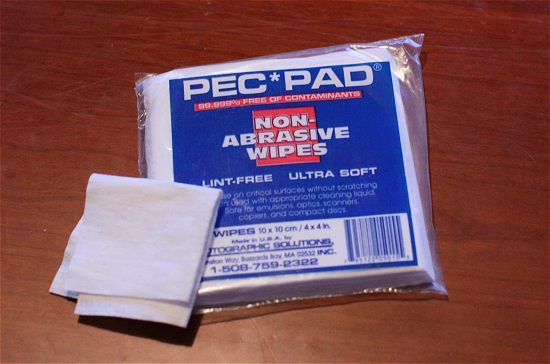 The resulting was spectacular. I found my original signal (and even better!). As you can be seen, the cleanliness of the fiber can be a source (sometimes) efficiency lost. Christian Buil |
|
| Autor: | Berthold Stober [ 12. Dezember 2012, 21:19:32 PM ] |
| Betreff des Beitrags: | |
Hello Christian, Very interesting.....in my case it have the same situation, I also must take away eache night the fiber from the fiberinjection . But it is not easy for me to get such lenspaper.... After 30 sec with my C11 beta ori create about 50.000 ADU in the brightest order. Other question I have. With ISIS one can create master flats, master darks and so on. Is it provided in ISIS to create a master thoargspectra too? I did not found this feature..... Cordialement Berthold |
|
| Autor: | Martin Dubs [ 12. Dezember 2012, 21:35:39 PM ] |
| Betreff des Beitrags: | |
Hello Christian, I also had this problem with dust on the fibers. I used a soft lens paper with some optical alcohol for cleaning with good success. Among the programs to remove water lines you should take a look at Peter Schlatters program Spectrotools http://www.peterschlatter.ch/SpectroTools/ with automatic adjustment of fitting parameters for shift, intensity and width of the lines. It also has the possibility to use atmospheres adapted to your observing conditions. (in german) Hallo Berthold, zum Entfernen der Wasserlinien verwende ich mit guten Resultaten das Programm Spectro Tools von Peter Schlatter, das er in Bad Boll vorgestellt hat: http://www.peterschlatter.ch/SpectroTools/ Hier findest Du das Programm mit geeigneten Referenzspektren der Atmosphäre und auch die Gebrauchanweisung. Die geeigneten Parameter findet das Programm automatisch nach einer groben Einstellung. Sehr empfehlenswert (mit Anleitung in Deutsch). Gruss, Martin |
|
| Autor: | Berthold Stober [ 12. Dezember 2012, 22:05:50 PM ] | |||
| Betreff des Beitrags: | ||||
Hello, here you see the result from delta ori 121211 from 6520 - 6620 dried and undried! I used the very comfortable program from Peter Schlatter to dry the spectrum..... berthold
|
||||
| Autor: | Christian Buil [ 13. Dezember 2012, 01:40:46 AM ] |
| Betreff des Beitrags: | |
Hello Berthold, A short answer (the topic is dedicated to Delta Ori  ) )Yes, it is possible to produce calibration images automatically (dark, bias AND ThAr from dedicated functions for echelle spectrograph). Some explanations here, but unfortunately in French for the moment: http://www.astrosurf.com/buil/isis/eshel/tuto1.htm (Automatic calibration images processing section). Note that in order to use the automatic possibilties in ISIS it is very important to name correctly the input images. If this strict protocol is followed, the processing is very simple and quick Christian |
|
| Autor: | Berthold Stober [ 13. Dezember 2012, 12:26:25 PM ] |
| Betreff des Beitrags: | |
Hello Christian, you see my spectrum from delta ori here. If I look for the S/N I see, that the S/N is about halpha perhaps 131 but in the region of 4500 or so, I find 350! I controlled these with midas procedure, so I don't believe it could be wrong. You find those different S/N too? I could not understand this because the CCD is not so sensitive in the blue one spectralregion that in the red one... très merveilleux...je pense.... cordialement berthold |
|
| Autor: | Bernard Heathcote [ 13. Dezember 2012, 15:14:16 PM ] | ||
| Betreff des Beitrags: | Request for observations of the 2mag star delta Orionis | ||
The SpectroTools program looks very interesting but unfortunately, for non-German readers, there does not appear to be an English version of the help files Cheers, Bernard From: Martin Dubs (fg-spek-convento@vds-astro.de) Sent: Thursday, December 13, 2012 6:35 AM To: fg-spek-convento@vds-astro.de (fg-spek-convento@vds-astro.de) Subject: [fg-spek] Re: Request for observations of the 2mag star delta Orionis Hello Christian, I also had this problem with dust on the fibers. I used a soft lens paper with some optical alcohol for cleaning with good success. Among the programs to remove water lines you should take a look at Peter Schlatters program Spectrotools http://www.peterschlatter.ch/SpectroTools/ with automatic adjustment of fitting parameters for shift, intensity and width of the lines. It also has the possibility to use atmospheres adapted to your observing conditions. (in german) Hallo Berthold, zum Entfernen der Wasserlinien verwende ich mit guten Resultaten das Programm Spectro Tools von Peter Schlatter, das er in Bad Boll vorgestellt hat: http://www.peterschlatter.ch/SpectroTools/ Hier findest Du das Programm mit geeigneten Referenzspektren der Atmosphäre und auch die Gebrauchanweisung. Die geeigneten Parameter findet das Programm automatisch nach einer groben Einstellung. Sehr empfehlenswert (mit Anleitung in Deutsch). Gruss, Martin No virus found in this message. Checked by AVG - www.avg.com Version: 2013.0.2805 / Virus Database: 2634/5952 - Release Date: 12/11/12
|
|||
| Autor: | Berthold Stober [ 14. Dezember 2012, 10:19:15 AM ] |
| Betreff des Beitrags: | Request for observations of the 2mag star delta Orionis |
Zitat: ----- Original Message -----
From: Tony Moffat (fg-spek-convento@vds-astro.de) To: fg-spek-convento@vds-astro.de (fg-spek-convento@vds-astro.de) Sent: Thursday, December 13, 2012 12:02 PM Subject: [fg-spek] Re: Request for observations of the 2mag star delta Orionis Very nice, Bernard! Keep it coming, especially starting next Monday (Dec 17) until Jan 7 in parallel with the MOST satellite. Cheers, Tony From: Bernard Heathcote (fg-spek-convento(==>)vds-astro.de ([email]fg-spek-convento(==>)vds-astro.de[/email])) Sent: Wednesday, December 12, 2012 4:55 AM To: fg-spek-convento(==>)vds-astro.de ([email]fg-spek-convento(==>)vds-astro.de[/email]) (fg-spek-convento(==>)vds-astro.de ([email]fg-spek-convento(==>)vds-astro.de[/email])) Subject: [fg-spek] Re: Request for observations of the 2mag star delta Orionis I was interested by the profile and velocity variation of the H-alpha and HeI lines over two consecutive nights (10th and 11th December). The RV shift is about 90 km/s, so is this the behavior we should expect to see for delta Ori? I've included the 'raw' spectra with the telluric lines, to show that the wavelength calibration is ok. Cheers, Bernard Quicquid Nitet Notandum Tony Moffat |
|
| Autor: | Thomas Eversberg [ 14. Dezember 2012, 11:29:02 AM ] |
| Betreff des Beitrags: | Campaign start |
A message from Noel Richardson. Dear all, I'm sending this email to people who have either expressed interest in helping with the delta Orionis campaign, as well as to some interested people for next summer's WR campaign. Please feel free to share this email with other people observing. Our space-based observations of delta Orionis begin next week, and it is time to start observing from the ground! The MOST satellite will begin observations on 17 Dec, continuing through 7 January. We should get a beautiful light curve of high accuracy for the 2000A wide filter of MOST. The satellite orbits every 110 minutes or so, with half of that time spent on delta Ori. We have confirmed two of the four visits for the Chandra satellite to be roughly 19 Dec (19:00 UT) to 21 Dec (4:00 UT) as well as 22 Dec (6:00 UT) to 23 Dec (16:00 UT). Ground based spectra are needed to update the orbital ephemeris and to disentangle the component spectra of the system. In addition, we will look to see if there is any unexpected emission from the system. With these goals, we plan on focusing on the H-alpha and He I 6678 region. Many amateurs have already shown that they can get one region or the other, with some people having the ability to obtain both simultaneously. We hope for high resolution (R>10,000), high SNR spectra (200 or better). These requirements should be able to be met with ease of even a small telescope as the star is V~2. Similarly, we should obtain at least one telluric standard star from each telescope/spectrograph combination. zeta Aql can be obtained early in the night with a high airmass, which is preferable. Alternately, we can observe beta Eri (which is closer in the sky) to map the telluric contamination for that site. For the telluric stars, we need at least one good telluric spectrum for each location, with the ideal being one per night. Ground based photometry may also be collected from amateur astronomers which can give us helpful color information. Jeff and I asked the AAVSO to use their Bright Star Monitor (BSM) to observe delta Ori, but haven't heard anything back on that yet. Data can be sent directly to myself. Reduced data are great, but I would like to see some raw data to ensure that all calibrations are done correctly so that all data can be used in the analysis. We look forward to a successful campaign and an abundance of multi-wavelength data from both the ground and space! Clear skies, Noel Richardson |
|
| Autor: | Berthold Stober [ 14. Dezember 2012, 12:36:00 PM ] |
| Betreff des Beitrags: | Request for observations of the 2mag star delta Orionis |
Hi Tony, yes I was wrong with beta ori, if we will have clear skies I can deliver some echelle spectra......... cheers berthold Zitat: ----- Original Message -----
From: Tony Moffat (fg-spek-convento@vds-astro.de) To: fg-spek-convento@vds-astro.de (fg-spek-convento@vds-astro.de) Sent: Thursday, December 13, 2012 12:02 PM Subject: [fg-spek] Re: Request for observations of the 2mag star delta Orionis Hi Berthold: The star of current interest is delta Ori (Mintaka), not beta Ori (Rigel) (although the latter is interesting anyway). Can you get spectra of delta Ori then? The MOST/Chandra campaigns start soon (Dec 17 for MOST, until Jan 7 and between Dec 20-27 for Chandra). Cheers, Tony From: Berthold Stober (fg-spek-convento(==>)vds-astro.de ([email]fg-spek-convento(==>)vds-astro.de[/email])) Sent: Wednesday, December 12, 2012 4:05 AM To: fg-spek-convento(==>)vds-astro.de ([email]fg-spek-convento(==>)vds-astro.de[/email]) (fg-spek-convento(==>)vds-astro.de ([email]fg-spek-convento(==>)vds-astro.de[/email])) Subject: [fg-spek] Re: Request for observations of the 2mag star delta Orionis Hello, now there you see my spectrum frm beta ori_121211. Christian:how do you proceed te remove the waterlines with isis? I load the full spektrum , normelize it, and then I look with 0.25 and play with the reglage but don't see a good result. I think, I do something wrong..... Tony: I shall try tio deliver more spectra of Rigel, so I ask if I can join to your campagne? cheers berthold Tony Moffat |
|
| Autor: | Hold Siegfried [ 14. Dezember 2012, 21:07:16 PM ] | ||
| Betreff des Beitrags: | |||
Hello, Here's a profile from 12.12.2012 exp. time = 30 min S / N = 218 (6620-6650) R = 13000 greeting Siegfried
|
|||
| Autor: | Bernard Heathcote [ 15. Dezember 2012, 15:29:01 PM ] |
| Betreff des Beitrags: | |
When Noel asks for 'raw data' what exactly does he want? I assume we should perform standard 'pre-processing' i.e. bias, dark and flat calibrations, and also wavelength conversion. Does he want instrumentation response corrections done, or will the 'standard telluric' star be used for that? I assume he doesn't want any normalisation, heliocentric correction, continuum or telluric line removals made. If, as I'm doing at the moment, I record a sequence of ten minute spectra, does he want all the individual spectra or the resulting stacked (2x600s) series? Clarification on this matter would be appreciated. Cheers, Bernard |
|
| Autor: | Jürgen Neubert [ 15. Dezember 2012, 20:43:32 PM ] |
| Betreff des Beitrags: | Request for observations of the 2mag star delta Orionis |
Am 15.12.2012 19:29, schrieb Berthold Stober: Zitat: Hi Tony,
yes I was wrong with beta ori, if we will have clear skies I can deliver some echelle spectra......... cheers berthold : ----- Original Message ----- From: Tony Moffat (fg-spek-convento(==>)vds-astro.de ([email]fg-spek-convento%28==%3E%29vds-astro.de[/email])) To: fg-spek-convento(==>)vds-astro.de ([email]fg-spek-convento%28==%3E%29vds-astro.de[/email]) (fg-spek-convento(==>)vds-astro.de ([email]fg-spek-convento%28==%3E%29vds-astro.de[/email])) Sent: Thursday, December 13, 2012 12:02 PM Subject: [fg-spek] Re: Request for observations of the 2mag star delta Orionis Hi Berthold: The star of current interest is delta Ori (Mintaka), not beta Ori (Rigel) (although the latter is interesting anyway). Can you get spectra of delta Ori then? The MOST/Chandra campaigns start soon (Dec 17 for MOST, until Jan 7 and between Dec 20-27 for Chandra). Cheers, Tony From: Berthold Stober (fg-spek-convento(==>)vds-astro.de ([email]fg-spek-convento(==>)vds-astro.de[/email])) Sent: Wednesday, December 12, 2012 4:05 AM To: fg-spek-convento(==>)vds-astro.de ([email]fg-spek-convento(==>)vds-astro.de[/email]) (fg-spek-convento(==>)vds-astro.de ([email]fg-spek-convento(==>)vds-astro.de[/email])) Subject: [fg-spek] Re: Request for observations of the 2mag star delta Orionis Hello, now there you see my spectrum frm beta ori_121211. Christian:how do you proceed te remove the waterlines with isis? I load the full spektrum , normelize it, and then I look with 0.25 and play with the reglage but don't see a good result. I think, I do something wrong..... 800)this.width = (800)" onclick=[url=javascript:window.open('http://spektroskopieforum.vdsastro.de/i ... 0,status=0')]"javascript:window.open('http://spektroskopieforum.vdsastro.de/i ... 0,status=0')"[/url] alt="Posted Image, might have been reduced in size. Click Image to view fullscreen." title="Posted Image, might have been reduced in size. Click Image to view fullscreen." border="0">Tony: I shall try tio deliver more spectra of Rigel, so I ask if I can join to your campagne? cheers berthold Tony Moffat |
|
| Autor: | Martin Dubs [ 16. Dezember 2012, 01:54:01 AM ] |
| Betreff des Beitrags: | |
Hello Bernard, Zitat: Bernard Heathcote
you can use Google translate http://translate.google.de/#de/en/http% ... roTools%2F for translating the content of the website. Translate also the two quick guides, one general operation of the program, the other especially for drying spectra. In addition you have to download an atmosphere, closest to your observing conditions (not critical).BeitragVerfasst am: 13. Dezember 2012, 14:14:16 Titel: Request for observations of the 2mag star delta Orionis The SpectroTools program looks very interesting but unfortunately, for non-German readers, there does not appear to be an English version of the help files Cheers, Bernard If you dry a spectrum it also gives you automatically the average calibration error over the selected range of wavelength. After getting used to it you will like it. Martin |
|
| Autor: | Noel Richardson [ 16. Dezember 2012, 04:36:43 AM ] |
| Betreff des Beitrags: | |
Hi Bernard, Basically, I want to make sure that everyone's reductions are done the same way and that the data are comparable from different telescopes. That in mind, the reduced (bias, dark, flat, ThAr calibrated) spectra are wonderful, but I want to do the reductions myself for one night from each person, so if you can send me the unprocessed images for at least one spectrum, that will be very helpful. If emailing it is a problem, then we can come up with another way to transfer files. Cheers, Noel Zitat: When Noel asks for 'raw data' what exactly does he want?
I assume we should perform standard 'pre-processing' i.e. bias, dark and flat calibrations, and also wavelength conversion. Does he want instrumentation response corrections done, or will the 'standard telluric' star be used for that? I assume he doesn't want any normalisation, heliocentric correction, continuum or telluric line removals made. If, as I'm doing at the moment, I record a sequence of ten minute spectra, does he want all the individual spectra or the resulting stacked (2x600s) series? Clarification on this matter would be appreciated. Cheers, Bernard |
|
| Autor: | Noel Richardson [ 16. Dezember 2012, 04:39:14 AM ] |
| Betreff des Beitrags: | |
Also, Bernard - Your spectra from 10-11 Dec are great! It looks like you are picking up signs of the secondary! (the indentations on the red side of the lines in the blue spectrum. |
|
| Autor: | Christian Buil [ 16. Dezember 2012, 05:56:11 AM ] | ||||
| Betreff des Beitrags: | 16.044 / 12 / 2012 obs. | ||||
Part of an eShel delta Ori spectrum taken the 16.044 / 12 / 2012 during a very short ten minutes weather windows (!). Note relatively modest SNR of 175 because bad weather conditions... Christian Buil
|
|||||
| Autor: | Bernard Heathcote [ 16. Dezember 2012, 08:58:06 AM ] |
| Betreff des Beitrags: | |
Hi Noel, Thanks for the clarification on what you want done (not done) with the spectra. If I understand correctly then I will need to send you a full (zipped) set of all individual raw spectra, including bias, dark, flat, calibration lamp and instrument response FITS for delta Ori and the companion A-type star (beta Eri in my case). Cheers, Bernard |
|
| Autor: | Berthold Stober [ 17. Dezember 2012, 10:01:55 AM ] |
| Betreff des Beitrags: | Request for observations of the 2mag star delta Orionis |
Hello Christian, how can I change the calibratuion of the y axis with ISIS in gnuplot? cordialement berthold |
|
| Seite 1 von 4 | Alle Zeiten sind UTC+02:00 |
| Powered by phpBB® Forum Software © phpBB Limited https://www.phpbb.com/ |
|
